
PEEK is a high-performance engineering thermoplastic used where ordinary plastics lack sufficient strength, temperature resistance or chemical stability. Even so, its outstanding material properties do not make it easy to machine. CNC machining of PEEK requires strict control of cutting heat, cutting force, chip evacuation and residual stress to hold consistent dimensional accuracy. For engineers designing medical devices, aerospace hardware and precision industrial components, thoughtful design choices before machining greatly improve part quality and production repeatability. We are a China CNC machining factory specializing in custom PEEK prototypes and low-volume precision parts for automation, medical, aerospace and e-bike projects. We help designers avoid common distortion and tolerance risks for PEEK machined components.
Definition
Polyether ether ketone (PEEK) is a semi-crystalline thermoplastic famous for its high strength-to-weight ratio, wear resistance, chemical resistance, and stable mechanical performance under elevated temperatures. It comes in multiple grades: unfilled natural PEEK, glass-fiber-reinforced PEEK and carbon-fiber-reinforced PEEK. Natural PEEK is preferred when electrical insulation, chemical resistance or medical compliance is required. Reinforced variants deliver higher stiffness and better dimensional stability, yet they are more abrasive and show anisotropic properties that must be considered during machining. Engineers often order CNC-machined PEEK prototypes from solid stock to validate geometry, assembly fit and functional performance before investing in molding tooling. Material grade selection must match the operating environment and compliance requirements of the final application.
How It Works
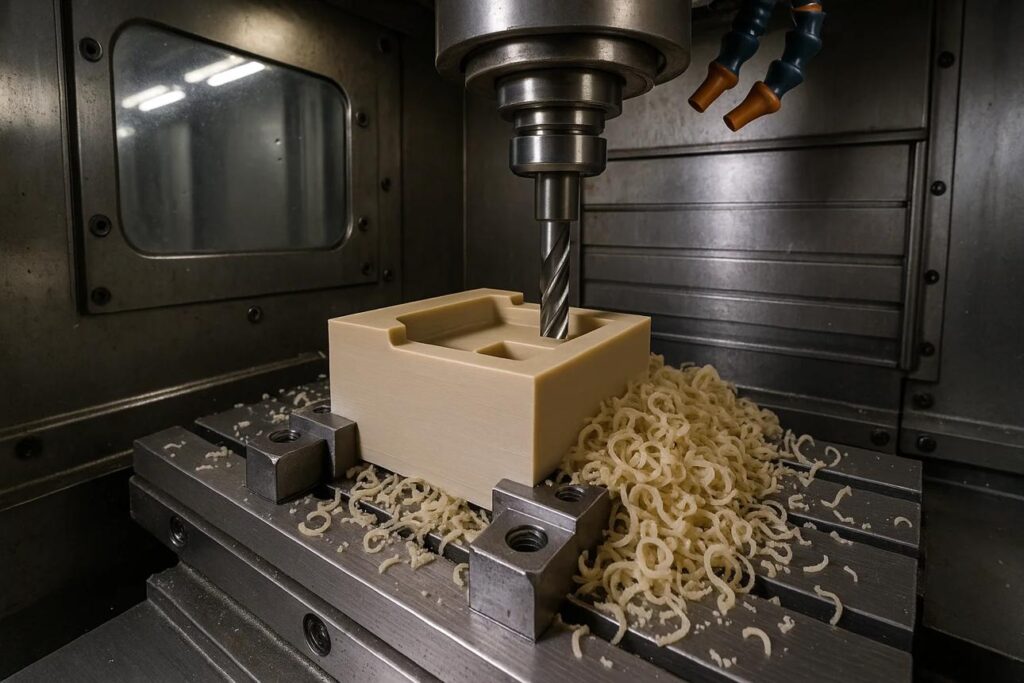
The standard PEEK machining workflow includes material incoming inspection, CAD/CAM programming, workholding setup, roughing, stress management, finish machining and final dimensional inspection. PEEK has much lower thermal conductivity than metals. Heat generated at the cutting zone accumulates quickly around the tool and workpiece. Excess heat softens the plastic, ruins chip formation and triggers dimensional drift. Sharp, well-polished cutting tools and stable cutting parameters help lower heat and cutting load. Reliable chip evacuation is critical: tangled or re-cut chips scratch finished surfaces and damage cutting edges. For tight-tolerance parts, a two-stage process works best: rough machining leaves a uniform finishing allowance, followed by stress relaxation if needed, then the final finishing pass.
Key Parameters
Machining settings vary based on PEEK grade, part geometry, tool material, machine rigidity and target surface finish.
表格
| Parameter | Machining consideration | Potential impact |
|---|---|---|
| Heat control | Use sharp tools, avoid rubbing instead of cutting | Prevent thermal softening and dimensional distortion |
| Cutting tools | Select polished, sharp carbide tooling | Improve surface finish and reduce material smearing |
| Chip evacuation | Use optimized toolpaths, air blast or compatible coolant | Avoid chip re-cutting and localized heat buildup |
| Workholding | Support thin walls; limit excessive clamping pressure | Reduce part deflection during machining |
| Stress relief | Add relaxation cycle between roughing and finishing | Minimize post-machining warping from residual stress |
| Tolerance setting | Assign tolerance based on function and PEEK behavior | Cut unnecessary inspection cost and scrap risk |
| Material grade | Separate natural, glass-filled and carbon-filled PEEK | Reinforced grades wear tools faster and behave differently |
Pros & Cons
PEEK brings clear advantages for high-demand engineering applications:
- High strength and stiffness compared with standard engineering plastics
- Excellent resistance to most chemicals and solvents
- Low moisture absorption rate
- Good wear and fatigue performance under proper design
- Continuous high-temperature service capability
- Medical and industrial certified grades available
Its drawbacks cannot be ignored: raw material cost is high, PEEK is sensitive to cutting heat and residual stress, and it requires specialized machining experience. Filled grades cause faster tool wear and anisotropic shrinkage. For regulated medical or aerospace parts, material certification, documentation and qualification add extra lead time and cost.
Typical Applications
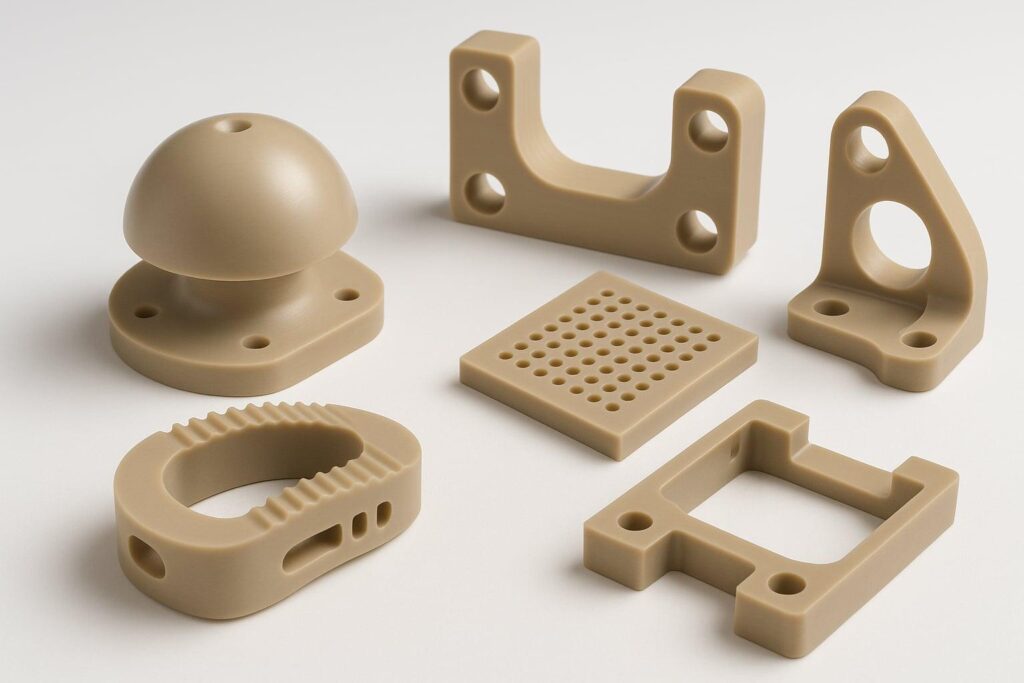
PEEK is widely adopted in aerospace, medical equipment, semiconductor, chemical processing and precision industrial machinery. In aerospace, machined PEEK parts act as electrical insulators, lightweight brackets and wear inserts, replacing metal where weight reduction is required under approved material specs. Medical-grade PEEK is used for instrument components, equipment housings and implant-related parts. Not all PEEK stock is implant-grade: implantable use needs verification of exact grade, cleaning process, sterilization compatibility, traceability and regulatory standards. General biocompatible labeling does not automatically qualify parts for human implantation. Industrial use cases include pump parts, valve seats, bushings, fixtures and wear components that need stable dimensions and chemical resistance.
Design & Machining Tips
Design your part for stable support and predictable material removal. Thin walls, narrow ribs, long unsupported sections and deep pockets easily deflect under cutting force or clamping pressure. Add reinforcing ribs where possible, and avoid abrupt section changes that concentrate internal stress. Do not assume PEEK dimensions stay stable right after roughing. Residual stress built into the raw stock and generated during cutting releases as material is removed, causing warping. A staged process — roughing → stress relaxation → finishing — is the proven way to control tolerance, following your PEEK supplier’s material guidance. Heat management is core. Always run sharp tools, maintain steady chip load and avoid prolonged tool rubbing. Air blast or compatible coolant helps chip removal and temperature control; confirm compatibility with downstream cleaning and sterilization requirements for medical parts. Do not clamp PEEK with heavy force. Use soft jaws, conformal fixtures to spread pressure evenly. For deep cavities, plan tool access and chip paths before machining. Inspect critical dimensions only after the part cools and stabilizes at inspection temperature. When designing a PEEK prototype, distinguish functionally critical dimensions from non-critical ones. Our team reviews stock condition, machining sequence, stress control and inspection rules before production for your low-volume custom PEEK parts.
FAQ
Why does PEEK deform easily during CNC machining?
PEEK has lower rigidity than metals and poor thermal conductivity. Cutting force and clamping pressure bend thin features; accumulated heat softens the cutting zone. Residual stress released while removing material also causes shift. Sharp tools, stable fixturing, controlled cutting parameters and staged machining greatly reduce deformation.
Is PEEK suitable for medical machined parts?
Specific PEEK grades are used in medical applications, but suitability depends on material grade, contact type, manufacturing controls, sterilization method and regulatory rules. A general biocompatible claim does not mean the finished part meets medical or implant requirements.
How to hold tight tolerances on PEEK CNC parts?
Use stable workholding, minimize cutting heat and force, and adopt roughing plus stress relaxation before finishing. Complete dimension inspection after thermal stabilization. Avoid applying tight tolerances to every feature unless required by function.


