
Choosing between 6061 and 7075 aluminum is a critical step when designing custom CNC machined components. Both alloys deliver excellent strength-to-weight ratios and good machinability, yet they differ sharply in mechanical strength, corrosion resistance, machining behavior and material cost. This comparison of aluminum 6061 vs 7075 CNC machining helps mechanical engineers, product designers and procurement buyers pick the right material for drone structures, industrial automation parts, precision fixtures and prototypes. This handbook breaks down their core properties and manufacturing traits to support practical, cost-effective material selection.
1. Introduction
Aluminum 6061 and 7075 are two of the most widely specified alloys in precision CNC manufacturing. 6061-T6 is the go-to choice for general-purpose machined parts, striking a balanced mix of strength, corrosion resistance, machinability and affordability. 7075-T6 is engineered for applications requiring superior mechanical strength and fatigue resistance, ideal for lightweight structural parts under heavy loads. Your final selection depends on the part’s mechanical demands, working environment, machining complexity and budget.
2. Definition & Basic Material Properties of 6061 and 7075 Aluminum
Both are heat-treatable aluminum alloys, but their alloying elements create very different mechanical performance. Values below reference common T6/T651 tempers; actual properties vary by stock form, thickness and material standard.
表格
| Property | 6061-T6 | 7075-T6 |
|---|---|---|
| Main alloying elements | Magnesium, silicon | Zinc, magnesium, copper |
| Density | 2.70 g/cm³ | 2.81 g/cm³ |
| Tensile strength | ~310 MPa | ~570 MPa |
| Yield strength | ~276 MPa | ~500 MPa |
| Elastic modulus | ~69 GPa | ~71 GPa |
| Corrosion resistance | Good | Moderate |
| Relative material cost | Lower | Higher |
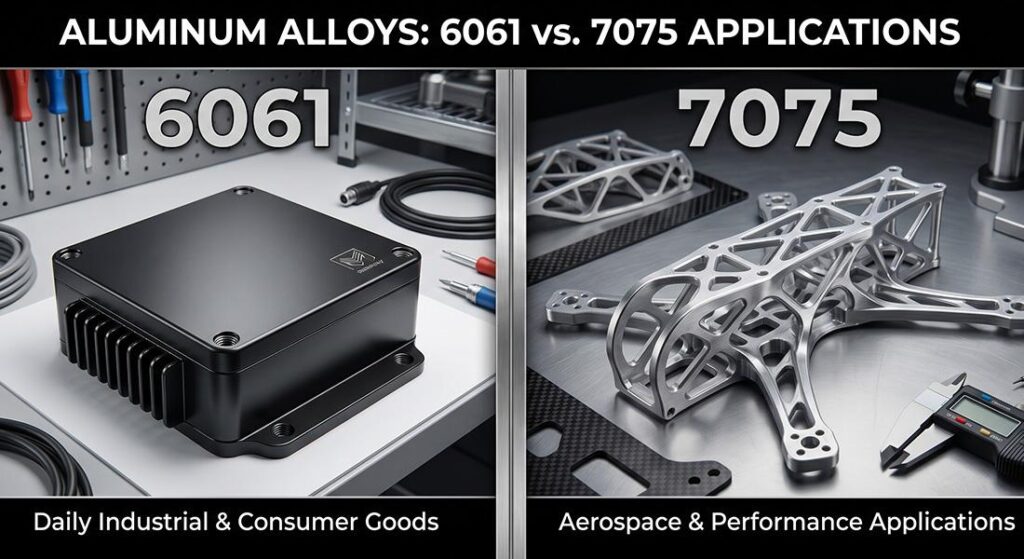
The biggest distinction is strength. 7075-T6 offers far higher tensile and yield strength than 6061-T6, with only a minor increase in density. This makes 7075 perfect for strength-critical lightweight structures. Still, higher strength does not make it the best fit for every use case.
3. Machining Characteristics Comparison
Both alloys work well for CNC milling, turning, drilling and tapping, but their mechanical differences shape cutting strategy.
Chip Removal 6061 produces manageable chips and runs smoothly with standard carbide tooling. It works great for complex pockets, threaded holes, brackets and general 6061 aluminum CNC parts. 7075 also machines well, but its higher strength calls for careful tuning of cutting parameters, tool geometry and workholding setup.
Tool Wear Sharp carbide tooling can machine both grades efficiently. 7075 needs closer monitoring of cutting forces and tool condition, especially during heavy stock removal or thin-wall machining. Proper tool selection, coolant and chip evacuation keep dimensions stable.
Residual Stress and Distortion Residual stress is a major concern for large blocks, thin walls and asymmetric parts. Stress-relieved 6061-T651 and 7075-T651 plate stock reduces distortion compared with non-stress-relieved material. For precision components, use balanced roughing, controlled stock removal and dedicated finishing passes.
Surface Finish Both alloys can achieve high-quality machined finishes. 6061 is widely used for cosmetic housings and anodized parts. 7075 can also yield fine finishes, though final appearance depends on tooling, cutting parameters, stock condition and post-treatment.
4. Strength, Weight, Corrosion Resistance & Anodizing
- Strength: 7075 is the stronger option for load-bearing structures, high-stress brackets and components under heavy mechanical loads. 6061 delivers adequate strength for most industrial applications.
- Weight: Both are lightweight. 7075 is roughly 4% denser than 6061; its strength advantage usually offsets this small weight penalty when structural performance is top priority.
- Corrosion resistance: 6061 has better inherent corrosion resistance. 7075 normally requires protective surface finishing, especially in humid or marine environments.
- Anodizing performance: Both can be anodized. 6061 delivers more consistent, uniform decorative anodizing results. 7075 can be anodized too, yet its high alloy content may lead to inconsistent color and surface appearance.
For either alloy, specify anodizing type, color, coating thickness and masking requirements clearly on drawings. Anodizing adds material thickness, so critical holes, threads, bearing surfaces and mating features must account for coating buildup and tolerance compensation.
5. Typical Application Scenarios
表格
| Application | Recommended material | Reason |
|---|---|---|
| Industrial automation brackets | 6061 | Balanced strength and low cost |
| Machine frames and housings | 6061 | Good machinability and corrosion resistance |
| Drone structural components | 7075 | Superior strength-to-weight ratio |
| Drone electronic housings | 6061 | Easy machining and reliable finishing |
| Precision fixtures | 6061 or 7075 | Depends on clamping load |
| High-load mounting components | 7075 | Higher yield strength |
| General prototypes | 6061 | Cost-effective and versatile |
Drone and Automation Parts
For drones, 7075 fits highly loaded motor mounts, structural connectors and lightweight parts that demand high stiffness-to-weight performance. 6061 is a practical pick for electronic enclosures, covers and mounting plates where corrosion resistance and cost matter more than maximum strength.
In industrial automation, 6061 is sufficient for brackets, sensor mounts, machine covers and fixture bases. 7075 is preferred for heavily loaded robotic interfaces, precision clamping hardware and high-stress mechanical connections.
6. Design & Sourcing Tips: When to Pick 6061 or 7075
Select aluminum grade based on real operating conditions, not just picking the strongest material available.
✅ Choose 6061 when:
- The part carries moderate mechanical loads
- Corrosion resistance is required
- Consistent anodized aesthetics are important
- You need cost-effective CNC machining
- It is a prototype or general automation component
✅ Choose 7075 when:
- High tensile or yield strength is mandatory
- Weight reduction under load is a key goal
- The part endures high clamping or structural stress
- The design requires strong lightweight mounting hardware
- Higher material cost is justified by performance needs
Extra sourcing guidance:
- Specify exact alloy and temper: e.g. 6061-T6 or 7075-T651
- Confirm material certification and traceability rules
- Mark critical dimensions and functional tolerances
- Discuss stress relief for large or thin-walled parts
- Define anodizing or other surface treatment specs
- Request drawing review before production
For overseas sourcing, clearly state material standards and stock form to avoid unauthorized material substitution that hurts part performance.
7. FAQ
- Is 7075 aluminum stronger than 6061 for CNC machining? Yes. 7075-T6 features much higher tensile and yield strength than 6061-T6, suited for heavily loaded structural parts. 6061 offers a balanced package of strength, corrosion resistance, machinability and lower cost.
- Is 6061 or 7075 better for drone parts? It depends on the component. 7075 works for high-stress motor mounts and structural connectors. 6061 is preferred for electronic housings, covers and mounting plates prioritizing corrosion resistance and cost control.
- Which aluminum alloy is easier to CNC machine and anodize? Both are machinable. 6061 is generally the better choice for consistent decorative anodizing and general manufacturing. 7075 can be machined and anodized, but its finish and corrosion protection need tighter process control.
8. Closing: Choosing the Right Aluminum for Your CNC Parts
6061 and 7075 each fill unique roles in precision CNC manufacturing. 6061 is versatile and economical for general industrial components, while 7075 excels where high mechanical strength and lightweight structural performance are required. Your final choice should balance mechanical requirements, corrosion resistance, machining complexity, finishing specs and total part cost.
Factory note: We are a China-based CNC shop. We manufacture custom precision CNC machined parts with no MOQ, supporting prototypes and production runs in 6061 and 7075 aluminum.


