Introduction
Material selection is one of the most important decisions in medical CNC machining. The material directly affects component strength, corrosion resistance, dimensional stability, sterilization compatibility, and biocompatibility. Choosing an unsuitable material can lead to premature component failure, manufacturing difficulties, or regulatory compliance issues.
For medical device manufacturers, the right choice depends on the component’s intended application, whether it contacts human tissue, its expected service life, and the operating environment. Surgical instruments, diagnostic equipment housings, orthopedic implants, and minimally invasive surgical components all have different material requirements.
This guide explains how to approach medical CNC machining material selection, compares commonly used metals and engineering plastics, and outlines the key factors engineers and procurement teams should evaluate before choosing a manufacturing material.
1. Understand the Application and Biocompatibility Requirements
The first step is to define how the CNC machined component will be used.
Medical components generally fall into several application categories:
- Surgical instruments: Require strength, wear resistance, corrosion resistance, and repeated sterilization compatibility.
- Medical equipment components: Often prioritize dimensional accuracy, structural stability, and resistance to cleaning chemicals.
- Orthopedic implants: Require carefully qualified biocompatibility, fatigue resistance, and long-term performance.
- Diagnostic equipment parts: May require lightweight construction, chemical resistance, and precise mechanical features.
For components that contact the human body, engineers must consider the nature and duration of contact. Biocompatibility evaluation should follow the applicable biological safety requirements, including relevant parts of ISO 10993.
Importantly, a material should not be considered biocompatible simply because it is commonly used in medical manufacturing. Its grade, composition, processing history, surface condition, and intended use all matter.
2. Compare Common Materials for Medical CNC Machining
Different applications require different material properties. The following materials are frequently considered when manufacturing medical grade CNC parts.
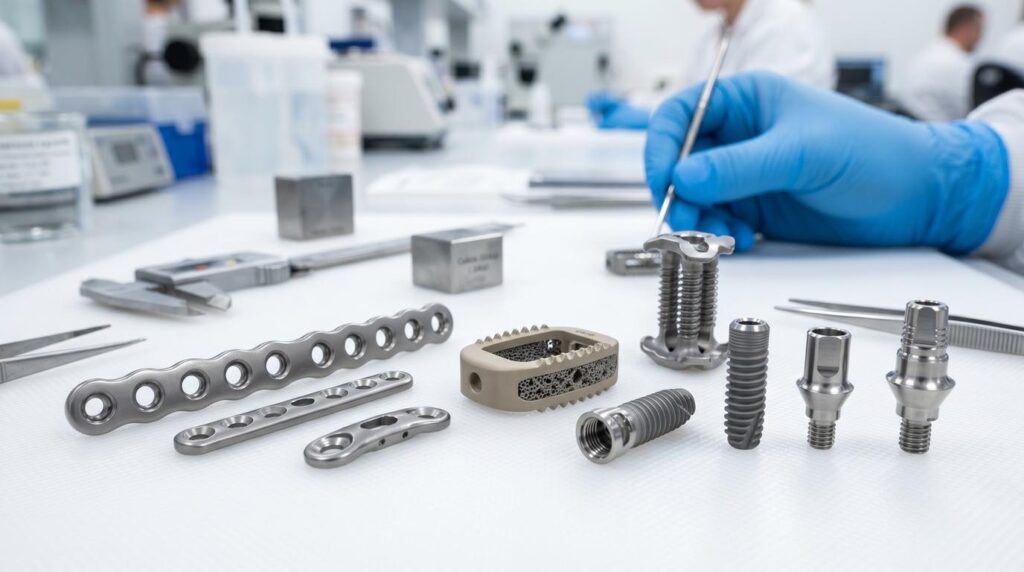
News – CNC Machining for Medical Implants: Complete Manufacturing Guide (2026)
Medical-grade titanium and stainless steel components produced through precision CNC machining.
| Material | Key properties | Typical medical applications |
|---|---|---|
| Titanium Ti-6Al-4V ELI | High strength-to-weight ratio, corrosion resistance, implant suitability | Orthopedic and dental implants |
| 316L stainless steel | Corrosion resistance, strength, machinability | Surgical instruments and implant components |
| 17-4 PH stainless steel | High strength, hardness, heat-treatable | Instrument mechanisms and equipment parts |
| PEEK | Lightweight, chemical resistance, dimensional stability | Implant components and medical equipment |
| Aluminum 6061 | Lightweight, machinable, cost-effective | Equipment housings and non-implant components |
Titanium Alloys
Titanium alloys are widely used in medical implant machining because of their high strength-to-weight ratio, corrosion resistance, and established use in implant applications.
Ti-6Al-4V ELI, specified under ASTM F136, is a common choice for orthopedic implants, bone fixation components, and dental applications. Its low interstitial content distinguishes the ELI grade from standard Ti-6Al-4V.
However, titanium presents machining challenges, including heat concentration, tool wear, and the need for carefully controlled cutting parameters. Manufacturers should consider these factors when evaluating production capability.
Medical-Grade Stainless Steel
Stainless steel is frequently selected for surgical instruments and medical components requiring strength and corrosion resistance.
316L stainless steel is commonly associated with implant applications under ASTM F138 and ISO 5832-1, while suitable stainless steel grades specified under ASTM F899 are used for surgical instruments.
17-4 PH stainless steel offers higher strength and hardness after appropriate heat treatment, making it useful for certain precision instrument mechanisms and equipment components. However, its suitability must be assessed against the intended biological contact and sterilization requirements.
PEEK Engineering Plastic
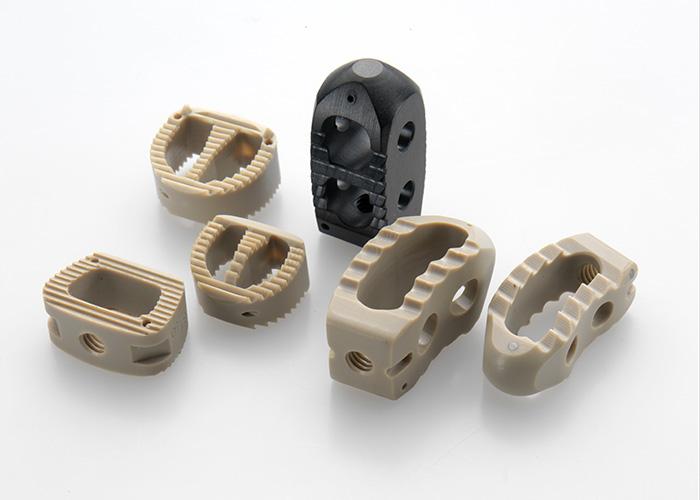
Medical devices – BBC Cellpack Technology AG
PEEK is a high-performance thermoplastic used in selected medical applications. Implant-grade PEEK materials specified under ASTM F2026 are used in applications such as spinal implant components.
Its advantages include low density, chemical resistance, and compatibility with certain sterilization methods. PEEK can also help reduce weight in medical assemblies.
Engineers should distinguish implant-grade PEEK from general industrial PEEK. Material certification, formulation, processing, and finished-part evaluation are essential before selecting it for patient-contact applications.
Aluminum Alloys
Aluminum alloys such as 6061 are suitable for many non-implant medical equipment components, including housings, mounting brackets, and structural frames.
Their low density and good machinability make them attractive for lightweight equipment designs. However, aluminum should not be treated as a general-purpose implant material. Its use must be limited to applications where its mechanical and biological characteristics meet the defined requirements.
3. Evaluate Key Material Properties
After identifying potential materials, engineers should compare their performance against the component’s actual operating requirements.
Mechanical strength and fatigue resistance
Components exposed to repeated loading require adequate tensile strength, yield strength, and fatigue performance. Implant screws, bone plates, and surgical mechanisms should be evaluated under realistic loading conditions rather than relying on tensile strength alone.
Corrosion resistance
Medical components may encounter bodily fluids, disinfectants, cleaning agents, and repeated sterilization cycles. Corrosion resistance is particularly important for reusable surgical instruments and implanted components.
Sterilization compatibility
Materials must withstand the sterilization method specified for the device, such as steam autoclaving, ethylene oxide, or radiation where applicable. Temperature, chemical exposure, and repeated cycles can affect material properties and surface conditions.
Machinability and dimensional stability
Complex medical CNC components often contain small features, tight tolerances, and fine surface finishes. Material machinability affects tool selection, production time, burr formation, and dimensional consistency.
Titanium and PEEK, for example, require different machining strategies. Engineers should consider both the material’s functional properties and the manufacturer’s ability to machine it reliably.
4. Consider Regulatory Requirements and Material Traceability
Material selection for medical manufacturing must be supported by appropriate documentation.
ISO 13485 certification is relevant because it establishes quality management requirements for medical device manufacturing and supplier control. However, it does not automatically approve a particular material or prove that a finished component is biocompatible.
Before production, sourcing teams should verify:
- Material grade and applicable ASTM or ISO specifications.
- Material test certificates and chemical composition.
- Heat or batch identification and traceability.
- Supplier qualification and material inspection procedures.
- Documented control of material substitutions and changes.
- Relevant biocompatibility and sterilization evidence.
For patient-contact components, FDA guidance on ISO 10993-1 emphasizes evaluating the finished medical device, including its materials, manufacturing processes, sterilization, and potential manufacturing residues. FDA+1
Material traceability is particularly important for implantable and safety-critical components. A supplier should be able to provide documentation linking the raw material batch to the manufactured parts.
5. Assess CNC Machining and Manufacturing Costs
The most suitable material is not necessarily the most expensive or highest-performing option. Engineers should balance functional requirements with manufacturing feasibility.
Consider these factors:
- Raw material cost: Titanium and implant-grade PEEK generally involve higher material costs than conventional aluminum and stainless steel.
- Machining complexity: Harder materials and difficult-to-machine geometries can increase tool wear and cycle time.
- Surface finishing: Polishing, passivation, and other finishing operations may be necessary depending on the application.
- Inspection requirements: Tight tolerances and critical dimensions may require additional metrology and documentation.
- Production volume: Prototype and low-volume orders may require different cost considerations from large-scale production.
For medical device development, custom low-volume CNC machining and prototype production can help validate material performance and component geometry before committing to larger manufacturing runs. A supplier offering flexible production without a minimum order quantity (MOQ) can also support early-stage development.
6. Verify the CNC Supplier’s Material and Quality Capabilities
Even a correctly specified material can produce an unsuitable component if machining and quality controls are inadequate.
When evaluating a CNC machining supplier, check whether the manufacturer can:
- Source materials with the required grade and supporting certificates.
- Maintain batch identification and material traceability.
- Control machining parameters for titanium, stainless steel, and PEEK.
- Meet drawing tolerances and surface-finish specifications.
- Perform dimensional inspection and maintain inspection records.
- Control cleaning, deburring, and finishing processes.
- Provide documented change management and nonconformance handling.
For overseas sourcing, these checks are particularly important. A Chinese CNC machining supplier should be evaluated on its documented quality processes, technical capability, inspection equipment, and ability to provide consistent material records—not simply its quoted price.
When comparing suppliers, review their experience with precision medical CNC machined components and request relevant material documentation before placing production orders.
Frequently Asked Questions
1. What are the most common biocompatible materials for medical CNC machining?
Commonly considered materials include Ti-6Al-4V ELI titanium, implant-grade 316L stainless steel, and implant-grade PEEK. Their suitability depends on the intended body contact, exposure duration, material specification, processing, and finished-device evaluation.
2. Does ISO 13485 certification affect material selection for medical parts?
ISO 13485 does not prescribe a universal list of acceptable materials. It establishes quality management requirements for purchasing controls, supplier evaluation, verification, and traceability. Manufacturers must still select materials that meet the device’s technical and regulatory requirements. U.S. Food and Drug Administration+1
3. Can medical CNC materials be used for both implants and surgical instruments?
Some material families, particularly titanium and stainless steel, are used in both applications. However, the required grade and specification may differ. Implant materials must meet the applicable long-term biological and mechanical requirements, while surgical instrument materials must also withstand their intended cleaning, sterilization, and operating conditions.
Conclusion
Selecting the right material for medical CNC machining requires more than comparing strength, hardness, or price. Engineers must consider intended use, biocompatibility, corrosion resistance, sterilization compatibility, machining feasibility, and material traceability.
Titanium alloys, medical-grade stainless steel, and implant-grade PEEK are important options for different medical applications, while aluminum and other engineering materials remain useful for non-implant equipment components.
By defining material requirements early and working with a qualified CNC machining supplier, medical device manufacturers can improve component reliability, manufacturing consistency, and regulatory readiness.