
Introduction
Aerospace manufacturing requires components that combine complex geometries, lightweight structures, high mechanical strength, and exceptional dimensional accuracy. From aircraft structural fittings and turbine components to engine housings and precision brackets, many aerospace parts contain angled surfaces, curved profiles, deep cavities, and intricate features that are difficult to manufacture using conventional 3-axis machining.
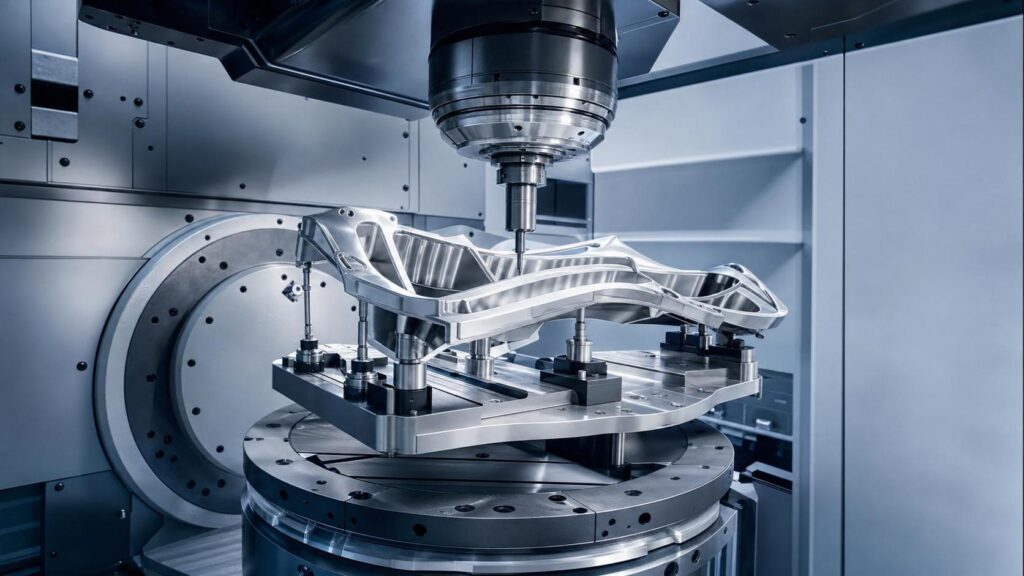
5 axis cnc aerospace machining provides an effective solution by allowing cutting tools to approach a workpiece from multiple directions in a single setup. By coordinating three linear axes (X, Y, and Z) with two rotational axes (A and B, or A and C, depending on the machine configuration), manufacturers can produce sophisticated aerospace components with fewer setups and improved machining consistency.
For aerospace engineers, product designers, and procurement professionals, understanding the benefits and limitations of 5-axis machining is important when selecting manufacturing processes for demanding applications. This guide examines its major advantages, material considerations, precision requirements, and practical design recommendations.
1. What Is 5-Axis CNC Machining in Aerospace Manufacturing?
5-axis CNC machining is a subtractive manufacturing process that moves a cutting tool or workpiece along five coordinated axes. Unlike traditional 3-axis machining, which primarily approaches the workpiece from one direction, 5-axis systems can machine multiple surfaces and complex angles through simultaneous or indexed movements.
The five axes generally include:
- X-axis: Horizontal movement.
- Y-axis: Front-to-back movement.
- Z-axis: Vertical movement.
- A-axis: Rotation around the X-axis.
- B-axis: Rotation around the Y-axis.
- C-axis: Rotation around the Z-axis, used in certain machine configurations.
In aerospace production, this flexibility is particularly valuable for components with compound curves, contoured surfaces, angled holes, and complex internal or external features.
2. Key Benefits of 5-Axis CNC Machining for Complex Aerospace Parts
2.1 Manufacturing Complex Geometries in Fewer Setups
One of the most significant advantages of 5-axis machining is its ability to access multiple surfaces without repeatedly repositioning the workpiece.
Traditional machining may require several fixtures and setups to produce angled features, curved profiles, or complex cavities. Every repositioning introduces potential alignment errors and additional production time.
With 5-axis machining, manufacturers can often complete multiple operations in a single setup. This is particularly useful for aerospace precision CNC parts such as turbine blades, engine brackets, structural fittings, and contoured housings.
Fewer setups also reduce fixture requirements and improve dimensional consistency between machined features.
2.2 Improved Dimensional Accuracy and Repeatability
Aerospace components frequently contain multiple precision features that must maintain accurate positional relationships.
Repeated workpiece repositioning can introduce cumulative alignment errors. 5-axis machining reduces this risk by allowing several features to be manufactured without removing the component from its original fixture.
This helps manufacturers achieve tighter geometric relationships, including:
- Accurate hole positioning and angular alignment.
- Consistent surface profiles.
- Improved concentricity between related features.
- Better positional accuracy across multiple machined surfaces.
For tight tolerance aerospace CNC applications, however, actual achievable accuracy depends on machine calibration, thermal stability, cutting tools, workholding, material behavior, and inspection methods.
2.3 Better Surface Finish on Curved and Angled Surfaces
Aerospace components often include aerodynamic contours, curved transitions, and sculpted surfaces that require controlled machining conditions.
5-axis machines can continuously adjust tool orientation to maintain a more favorable cutting angle. This helps reduce excessive tool engagement, uneven cutting forces, and unwanted surface marks.
The approach is particularly beneficial for:
- Turbine blade profiles.
- Aircraft aerodynamic structures.
- Complex aluminum housings.
- Curved titanium components.
Appropriate toolpath strategies and cutting parameters remain essential for achieving the required surface finish.
2.4 Reduced Machining Time and Production Costs
Although 5-axis CNC equipment generally involves higher initial investment and programming complexity, it can reduce total manufacturing costs for geometrically complex aerospace components.
Potential savings come from:
- Fewer machining setups.
- Reduced fixture changes.
- Shorter production cycles.
- Less manual repositioning.
- Lower risk of setup-related scrap.
- Reduced secondary machining operations.
For complex components manufactured in small or medium batches, these advantages can offset the higher hourly machine rate.
2.5 Supporting Lightweight Aerospace Structures
Weight reduction is a major objective in aircraft and spacecraft engineering. Manufacturers frequently machine components from solid aluminum or titanium billets to create lightweight structures with pockets, ribs, thin walls, and optimized contours.
5-axis machining provides access to difficult-to-reach surfaces and angled features, making it easier to manufacture these complex designs.
This is particularly valuable for lightweight brackets, structural connectors, mounting components, and other parts where material must be removed strategically without compromising structural integrity.
3. Common Aerospace Components Manufactured with 5-Axis CNC
Multi-axis machining aerospace components is particularly useful when conventional machining cannot efficiently reach all required surfaces.
Typical applications include:
| Component | Manufacturing requirements |
|---|---|
| Turbine blades and blisks | Complex airfoil profiles and smooth surface transitions |
| Aircraft structural brackets | Lightweight pockets, angled holes, and precise mounting interfaces |
| Engine housings | Complex cavities, accurate bores, and dimensional stability |
| Wing and fuselage fittings | Thin-wall structures and accurate geometric relationships |
| Satellite structural components | Lightweight designs and precision-machined interfaces |
| Aerospace manifolds | Multiple intersecting passages and angled features |
For these applications, the choice between 3-axis, 4-axis, and 5-axis machining should be based on part geometry, tolerance requirements, production volume, and total manufacturing cost.
4. Materials Commonly Used for Aerospace CNC Machined Parts
Material selection directly affects component weight, mechanical strength, corrosion resistance, heat resistance, and machining difficulty.
The following materials are widely used in aerospace precision CNC parts manufacturing.
4.1 Aluminum Alloys
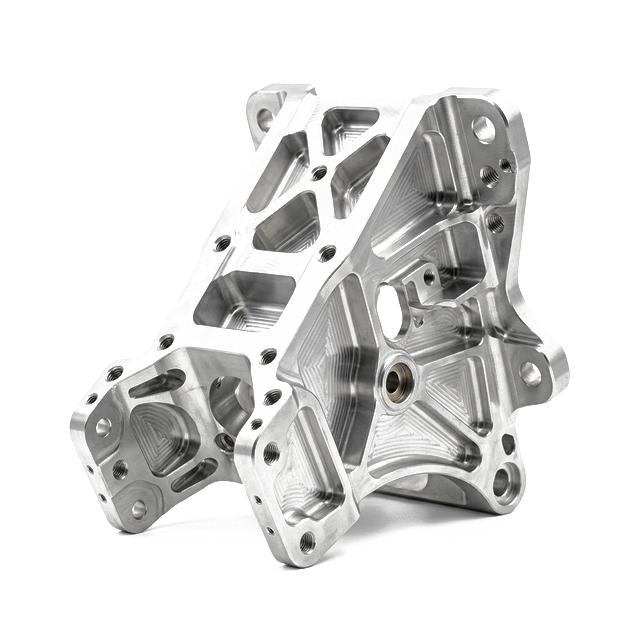
Common grades include 6061, 2024, and 7075 aluminum.
- 6061-T6: Offers good machinability, corrosion resistance, and versatility for structural and non-flight-critical components.
- 2024-T3: Provides a favorable strength-to-weight ratio and is commonly used in aircraft structures.
- 7075-T6: Offers high strength and is suitable for demanding structural fittings and brackets.
Aluminum is generally easier to machine than titanium and nickel-based superalloys, making it suitable for complex lightweight components.
4.2 Titanium Alloys
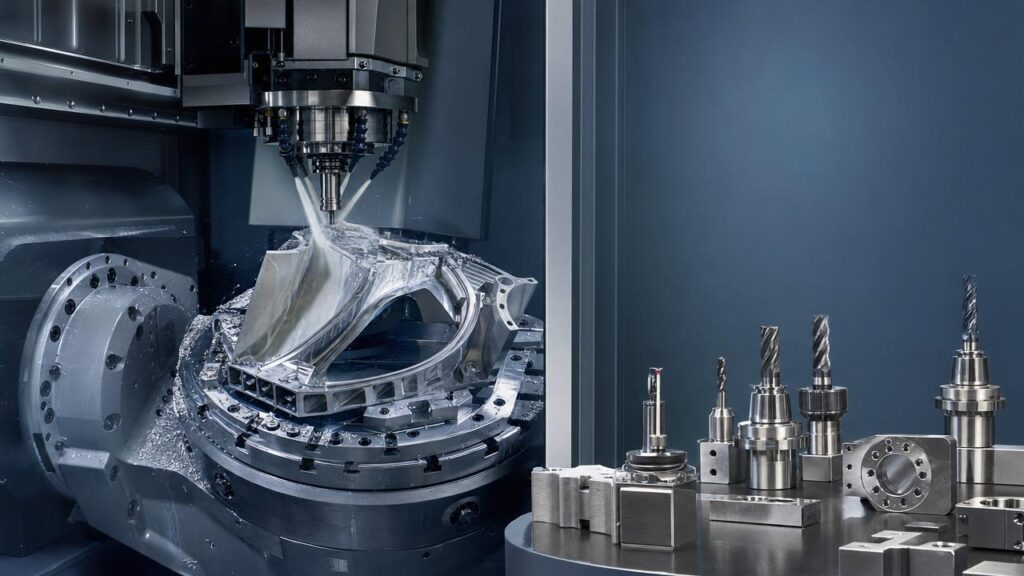
Ti-6Al-4V is one of the most widely used titanium alloys in aerospace manufacturing.
Its main advantages include:
- High strength-to-weight ratio.
- Excellent corrosion resistance.
- Good fatigue performance.
- Strong mechanical properties at elevated temperatures compared with many aluminum alloys.
However, titanium has relatively low thermal conductivity and can generate substantial heat during machining. Manufacturers need rigid workholding, suitable carbide tooling, controlled cutting parameters, and effective coolant delivery.
4.3 Nickel-Based Superalloys
Inconel 718 and other nickel-based alloys are used in high-temperature aerospace applications, particularly engine and turbine components.
These materials maintain mechanical strength under demanding thermal conditions. However, their high cutting resistance and work-hardening characteristics make machining more challenging.
5-axis machining can improve tool accessibility and tool orientation when manufacturing complex turbine-related geometries.
4.4 Stainless Steel and Other Engineering Materials
Aerospace manufacturers also use stainless steels such as 15-5 PH and 17-4 PH for components requiring strength, corrosion resistance, or specific mechanical properties.
Material selection should always follow the engineering drawing, applicable aerospace material specifications, and component service requirements.
5. Tolerance and Quality Requirements for Aerospace CNC Components
Aerospace manufacturing requires more than achieving accurate dimensions. Components must also satisfy geometric tolerances, surface-finish specifications, material requirements, and documented inspection procedures.
Typical precision machining targets may include:
| Feature or requirement | Illustrative machining target |
|---|---|
| General machined dimensions | ±0.05–0.10 mm |
| Precision mounting features | ±0.01–0.025 mm |
| Critical bores and interfaces | ±0.005–0.01 mm, where specified |
| Surface finish | Ra 0.8–1.6 μm for selected machined surfaces |
These are illustrative manufacturing capability targets, not universal aerospace standards. Actual requirements must come from the component drawing and applicable specifications.
Several quality frameworks and inspection standards are relevant:
- AS9100: Aerospace quality management system requirements.
- ASME Y14.5: Geometric dimensioning and tolerancing (GD&T).
- AS9102: First Article Inspection (FAI) requirements.
- NADCAP: Accreditation program covering specified special processes, such as heat treatment and chemical processing.
A coordinate measuring machine (CMM), calibrated inspection equipment, in-process probing, and documented material traceability help verify that finished components meet engineering requirements.
For especially demanding five-axis operations, machine kinematic calibration and dynamic tool-center-point accuracy are also important considerations. ibspe.com+2
6. Design and Manufacturing Tips for Better 5-Axis Machined Parts
Even advanced CNC equipment cannot compensate for an inefficient component design. Engineers should consider manufacturability early in the design process.
6.1 Avoid Unnecessarily Thin Walls
Thin walls can deform under cutting forces and residual-stress release, particularly when machining large aluminum or titanium components.
Where possible, maintain sufficient wall thickness and use supporting ribs to improve structural stiffness.
6.2 Optimize Internal Corner Radii
Small internal radii require smaller cutting tools, which can increase machining time and tool deflection.
Designing practical internal corner radii helps improve tool accessibility and reduce unnecessary finishing operations.
6.3 Consider Tool Accessibility
Although 5-axis machines provide greater tool access, deep cavities and narrow openings can still create interference and vibration problems.
Engineers should review tool approach angles, holder clearance, and workpiece orientation during the CAM programming stage.
6.4 Specify Functional Tolerances
Not every surface requires extremely tight tolerances.
Apply tight dimensional and geometric tolerances only to critical interfaces, bearing surfaces, mounting features, and other functional areas. This helps control machining costs without compromising component performance.
6.5 Verify Supplier Quality and Traceability
When sourcing aerospace components from China, buyers should evaluate more than machine capacity.
Important supplier verification points include:
- Available 5-axis CNC equipment and machining envelope.
- Experience with aluminum, titanium, and nickel alloys.
- Engineering support and DFM capability.
- Inspection equipment and CMM measurement capability.
- Material certificates and batch traceability.
- Quality management certifications and documented inspection procedures.
- Experience handling prototype, low-volume, and production orders.
A supplier’s certifications should be verified against the actual facility and processes involved in the order. Not every CNC machining factory is qualified to manufacture flight-critical components.
7. How to Select a 5-Axis CNC Machining Supplier
Choosing the right manufacturing partner is essential for complex aerospace projects.
A capable supplier should demonstrate experience with simultaneous 5-axis machining, complex toolpath programming, precision workholding, and process control.
Before placing an order, consider requesting:
- Previous examples of comparable aerospace components.
- Material certificates and traceability documentation.
- CMM inspection reports or sample FAI documentation.
- Evidence of relevant quality certifications.
- DFM feedback covering tolerances, wall thickness, and machining accessibility.
For international buyers, communication, engineering responsiveness, export documentation, and production scheduling should also be evaluated.
For additional technical information, see 5-axis CNC machining for aerospace applications.
8. Frequently Asked Questions
1. Why is 5-axis machining preferred for aerospace complex parts?
5-axis machining is preferred because it can produce complex geometries, angled features, and curved surfaces with fewer workpiece setups. This reduces setup-related positioning errors, improves tool accessibility, and can produce better surface finishes. It is particularly useful for turbine blades, structural fittings, engine housings, and other geometrically demanding aerospace components.
2. What tolerance standards are typical for aerospace CNC components?
There is no single universal dimensional tolerance for all aerospace CNC components. Requirements are defined by engineering drawings, GD&T specifications, and applicable industry standards. General dimensions may use tolerances around ±0.05–0.10 mm, while critical interfaces may require ±0.01 mm or tighter. ASME Y14.5 provides GD&T principles, while AS9100 and AS9102 address quality management and first-article inspection.
3. What materials are commonly used for aerospace CNC machined parts?
Common materials include 6061, 2024, and 7075 aluminum alloys; Ti-6Al-4V titanium; Inconel 718 nickel-based superalloy; and precipitation-hardening stainless steels such as 15-5 PH and 17-4 PH. The final selection depends on weight, strength, fatigue performance, corrosion resistance, temperature exposure, and the component’s operating environment.


