
Introduction
Choosing the right CNC machining process is critical for precision mechanical components. Engineers, sourcing managers and hardware manufacturers often compare Swiss CNC turning and 5-axis CNC machining. Both deliver high-precision parts, yet they differ greatly in machining principle, suitable geometry, throughput and cost structure.
Swiss CNC turning excels at small-diameter, slender, rotationally symmetrical parts. 5-axis machining, by contrast, offers unmatched flexibility for complex shapes, angled features and parts requiring multi-angle access.
Understanding the difference between Swiss turning and 5-axis machining helps buyers match the manufacturing method to part design, tolerance requirements, order volume and budget. This guide covers how each process works, their core distinctions, typical use cases and key factors for sourcing precision machined parts.
1. What Is Swiss CNC Turning?
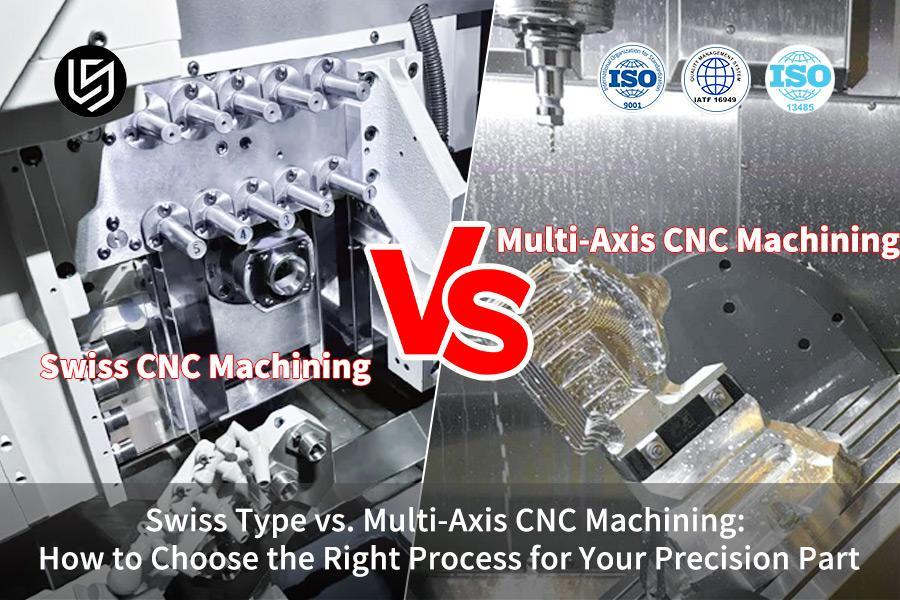
Swiss CNC turning is a precision subtractive process built for small, slender cylindrical components.
Unlike standard lathes, Swiss machines use a sliding headstock and guide bushing to support the workpiece right next to the cutting zone. This drastically reduces deflection and vibration, which is essential for long, thin parts with tight tolerances. Tools cut close to the guide bushing, maintaining stable dimensional accuracy throughout the run.
Key Characteristics
- Optimized for small-diameter workpieces
- Ideal for long, slender parts
- Excellent repeatability and concentricity
- High efficiency for rotational symmetrical parts
- Multi-operation completion in one setup
- Fits low to medium volume precision runs
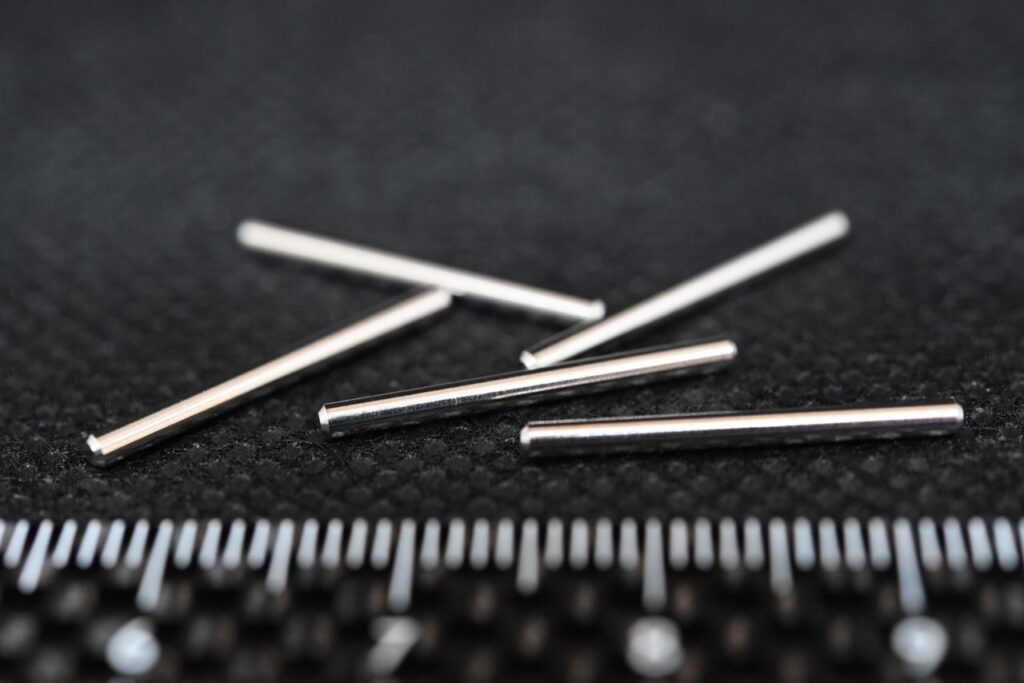
Common Swiss turned parts include precision shafts, pins, bushings, threaded connectors, miniature fasteners, medical pins and electronic fittings. It is the preferred choice when concentricity, surface finish and consistent dimensions are priorities.
2. What Is 5-Axis CNC Machining?
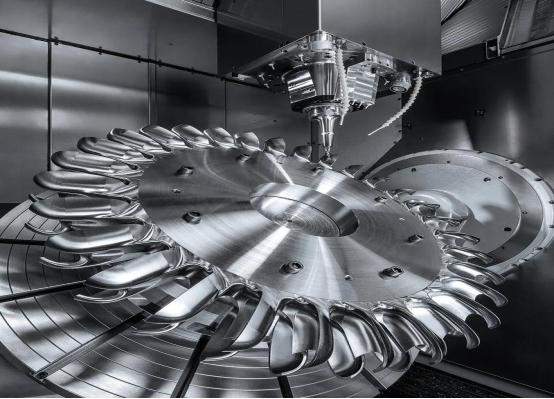
5-axis CNC machining controls tool movement along five independent axes to create complex parts. A standard 3-axis mill moves on X, Y and Z linear axes. 5-axis machines add two rotational axes, letting the cutting tool or workpiece approach features from nearly any angle.
This eliminates repeated re-fixturing, making angled holes, curved surfaces and compound contours manufacturable in fewer setups.
Key Characteristics
- Produces intricate 3D geometries
- Machines multiple faces in a single setup
- Supports angled holes and complex curved profiles
- Minimizes alignment error from repeated repositioning
- Works for metals and engineering plastics
- Great for one-off prototypes and low-volume complex components
Typical applications: aerospace brackets, turbine parts, precision housings, medical equipment structures, automotive fixtures and custom industrial components.
3. Swiss CNC Turning vs 5-Axis Machining: Key Differences
表格
| Comparison | Swiss CNC Turning | 5-Axis CNC Machining |
|---|---|---|
| Core process | Turning | Multi-axis milling |
| Best geometry | Small, cylindrical, rotational parts | Complex 3D non-symmetric geometries |
| Workpiece support | Guide bushing | Custom fixturing |
| Primary use cases | Shafts, pins, bushings, threaded pins | Housings, brackets, complex structural parts |
| Strength | Superior concentricity for slender turned parts | Flexibility for multi-sided complex features |
| Material range | Metals, machinable plastics | Metals, plastics, high-performance alloys |
| Efficiency | High for repeatable small turned parts | High for complex parts with many angles |
The core difference comes down to geometry: Swiss turning is built for round, slender parts. 5-axis milling is designed for shapes that cannot be easily produced by turning. Neither process is universally superior; selection depends on your engineering requirements.
4. When Should You Choose Swiss CNC Turning?
Pick Swiss CNC turning when your part is mainly cylindrical and requires consistent tight tolerances across small features.
- Precision shafts & slender pins: demanding concentricity, diameter and surface finish
- Small threaded hardware: studs, connectors and miniature fasteners
- Medical components: small instrument pins and implant-related hardware
- Electronic components: contacts, spacers and miniature fittings
- Small fluid fittings and adapters
Swiss machining is cost-effective for repeat production because turning, grooving, threading and cross-drilling can run in one cycle. It is not the best choice for parts dominated by large pockets, wide flat surfaces or non-rotational complex profiles.
5. When Should You Choose 5-Axis CNC Machining?
Choose 5-axis machining when the part geometry cannot be efficiently made by turning.
- Complex industrial housings with pockets, mounting bosses and angled openings
- Aerospace lightweight structural parts with freeform surfaces
- Automotive precision brackets and engine components
- Medical equipment housings and complex frames
- Custom one-off or low-volume parts with unique geometry
The biggest advantage is fewer setups. Less repositioning reduces cumulative alignment error and improves consistency for complex assemblies.
6. Cost and Production Efficiency Considerations
Pricing is not only based on machine hourly rates. Part geometry, setup time, stock material, tooling, inspection and order quantity all affect the final quote.
Swiss Turning Costs Bar-fed Swiss machines are economical for repeated small-part runs. But guide bushing matching, programming and special tooling can raise initial setup cost for new, non-standard parts.
5-Axis Machining Costs 5-axis equipment carries higher operating and programming overhead. Custom fixtures and special cutters can increase cost. However, consolidated setups may shorten total lead time for complex multi-face parts.
Key cost factors to review
- Part size and geometric complexity
- Material grade and stock availability
- Tolerance and surface finish requirements
- Cycle time
- Order quantity
- Fixture and tooling needs
- Inspection and secondary finishing
When comparing quotes, evaluate total landed cost rather than only unit price.
7. Can Swiss Turning and 5-Axis Machining Be Combined?
Yes. Many parts need both turning and milling features. For example, a precision shaft may have cylindrical turned profiles, threads and grooves, plus angled holes or milled flats. Depending on design, manufacturers can use Swiss machines with live tooling, or separate Swiss turning followed by 5-axis milling. A DFM review helps decide the optimal manufacturing route, especially for hybrid parts combining rotational symmetry and complex milled features.
8. Tips and Best Practices for Selecting a CNC Machining Process
Before sending out RFQs, engineering and sourcing teams should check these points:
- Analyze part geometry first: Is it mostly cylindrical, or full of complex multi-sided features?
- Define critical dimensions and GD&T requirements for concentricity, position, flatness and runout.
- Confirm production volume: Swiss turning shines for repeat small runs; 5-axis suits flexible prototype and low complex batches.
- Lock in material grade and any certification requirements.
- Submit complete documentation: 2D drawings, 3D CAD, surface finish, tolerance and quantity.
- Request a DFM review from your supplier to identify access issues, tooling constraints and cost-saving opportunities.
Frequently Asked Questions
Q1. What parts are best suited for Swiss CNC turning? A1. Swiss CNC turning is ideal for small-diameter, slender, rotationally symmetrical parts including shafts, pins, bushings, threaded connectors and miniature fasteners. It is the top choice when tight concentricity and consistent dimensional control are required.
Q2. Can 5-axis machining replace Swiss turning for small shafts? A2. Not usually. 5-axis can machine some small shafts, but Swiss turning is far more efficient for long, slender cylindrical parts in repeated runs. 5-axis makes sense only when the shaft has complex milled features or angled geometry that turning cannot easily achieve.
Q3. What is the typical lead time for Swiss turned components? A3. Simple Swiss turned parts usually take 5–15 business days, subject to material stock, complexity, quantity, tooling and inspection. Special materials, tight tolerance controls or post-finishing will extend lead time. Always confirm lead time before order placement.
Final Thoughts
Swiss CNC turning and 5-axis machining serve different, sometimes complementary roles. Swiss turning is optimized for small, slender cylindrical precision parts. 5-axis machining delivers the freedom to produce intricate multi-surface geometries.
For mechanical engineers and sourcing professionals, the right process selection depends on part design, functional specs, order volume, material choice and overall manufacturing cost. Early evaluation helps you pick the most efficient workflow, stabilize quality and avoid unnecessary manufacturing expenses.


