
- The drone industry demands mechanical parts that balance lightweight construction, high structural strength, and ultra-tight precision. Whether for commercial UAVs or industrial inspection drones, every component must hold dimensional accuracy under vibration, impact, and continuous flight loads.
- Traditional manufacturing struggles to deliver the intricate geometries and strict tolerances drone designs require. While 3D printing works well for rapid prototypes, it rarely matches the mechanical strength, dimensional stability, and premium surface finish needed for production-grade drone hardware.
- 5 axis CNC machining delivers drone OEMs a proven manufacturing solution for complex, lightweight and long-lasting components. By machining multiple surfaces in a single fixture setup, 5-axis CNC improves accuracy while cutting lead times for critical drone assemblies.
Why 5-Axis CNC Is Ideal for Drone Component Manufacturing
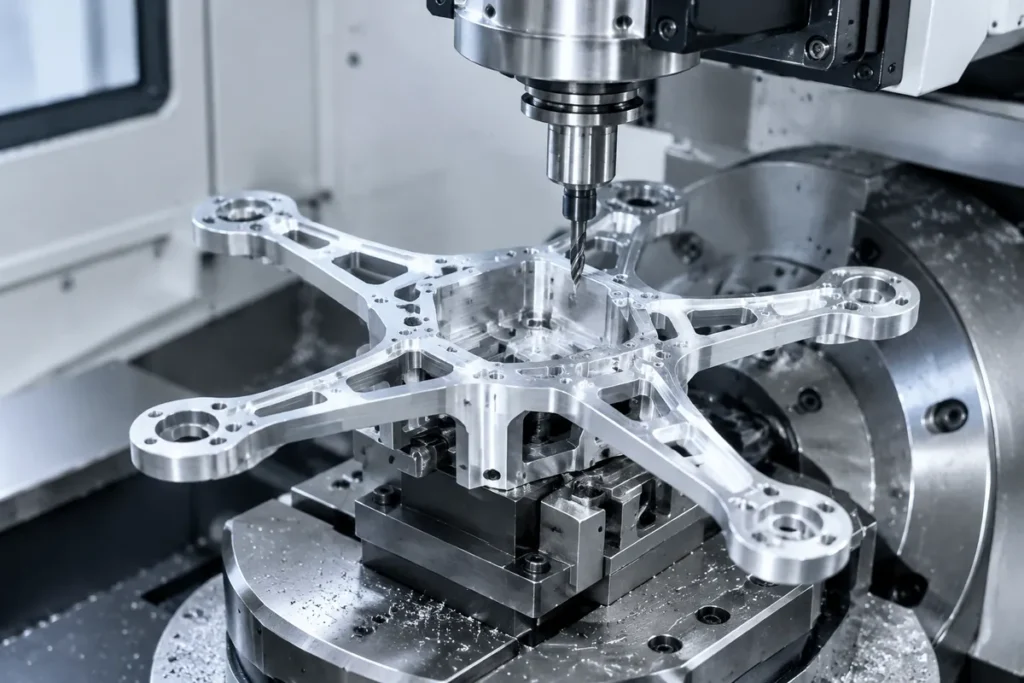
- Drone components often include compound angles, curved profiles, and thin-wall lightweight structures. Drone frame arms, motor mounts, landing gear brackets and gimbal housings all rely on precise machining to preserve balance and stable flight performance.
- A 5-axis CNC machine lets cutting tools reach the workpiece from multiple angles without repeated re-clamping. This minimizes setup errors and delivers consistent results for parts with sophisticated geometry.
- Compared to standard 3-axis CNC milling, 5-axis accesses hard-to-reach features and achieves smoother surface finishes. Design engineers can build high-strength structures optimized for weight reduction without sacrificing mechanical performance.
- Vibration resistance is non-negotiable for commercial drone systems. Poorly machined mounting surfaces or misaligned features trigger unwanted vibration, which degrades motors, camera payloads and flight control electronics.
- Well-executed 5-axis CNC processes produce precision parts with stable dimensions and seamless assembly. This capability is especially valuable for drone developers building high-performance UAV platforms.
Common CNC Machined Drone Parts & Material Selection
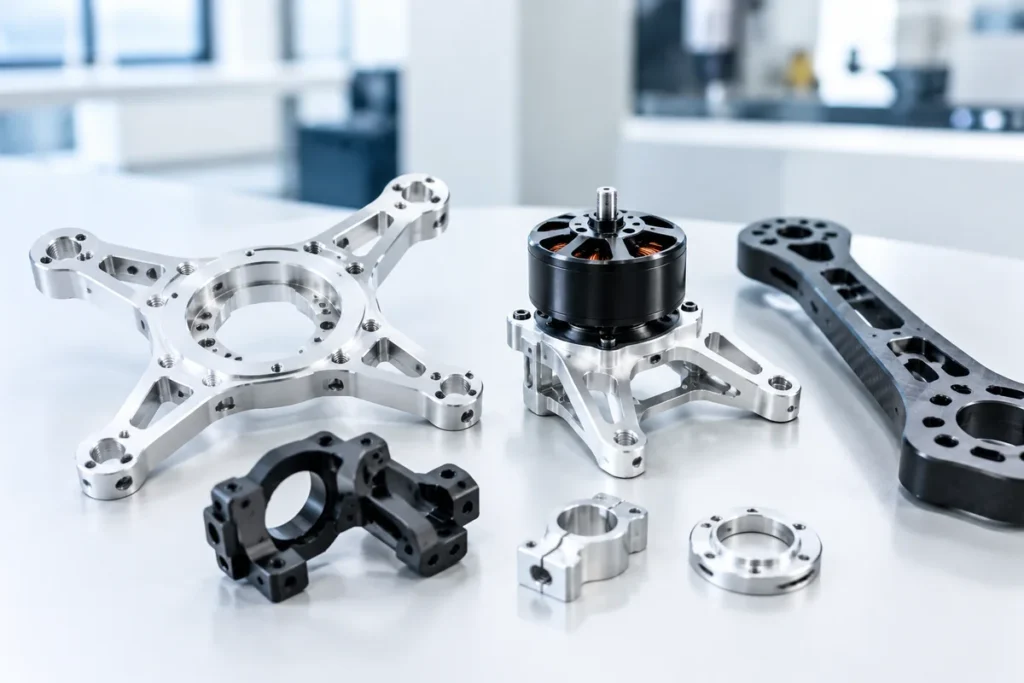
CNC machining manufactures a wide range of core drone hardware, including:
- Drone frame arms and structural support brackets
- Motor mounts and propulsion system components
- Landing gear assemblies
- Camera and gimbal mounting hardware
- Battery housings and protective enclosures
- Custom mechanical connectors
Material selection directly shapes drone flight performance. Engineers need to trade off strength, weight, corrosion resistance and production cost when selecting raw materials.
Aluminum alloys remain the top choice for drone manufacturing. Aluminum CNC drone parts machined from 6061 offer excellent machinability, corrosion resistance and sufficient strength for most commercial UAV structures.
For high-load applications, 7075 aluminum delivers superior strength-to-weight ratio. It is widely used for load-bearing structural components such as reinforced frame sections and heavy-duty motor brackets.
Engineering plastics also serve targeted use cases. POM fits low-friction moving parts, PA66 provides reliable impact resistance, and PEEK is reserved for extreme environments needing thermal and chemical resistance.
Carbon fiber composites dominate ultra-lightweight drone structures. CNC machining creates accurate mounting interfaces and connection hardware that pairs perfectly with composite assemblies.
Experienced machining partners help designers pick the optimal material according to operating conditions, batch volume and performance targets. This workflow delivers reliable custom drone cnc components for all types of UAV projects.
Critical Tolerance & Quality Considerations for Drone CNC Parts
- Drone flight performance heavily depends on machining precision. Tiny dimensional deviations on motor mounts, frame joints or gimbal hardware can throw off alignment, amplify vibration and compromise flight stability.
- Quality-focused CNC shops maintain strict QC throughout production runs. Metrology tools including CMMs, height gauges and surface profilometers validate all critical dimensions.
For precision CNC machined drone frame parts, engineers should define tolerance specs at the design phase. Mounting holes, bearing seats and assembly interfaces require precise positioning to guarantee seamless fit.
Surface finish deserves attention too. Smooth machined surfaces reduce wear, simplify assembly and create a clean finished look for commercial drone products.
DFM (Design for Manufacturability) optimization lowers production costs. Engineers can collaborate with CNC suppliers early to simplify machining operations while keeping all functional requirements intact.
What to Look for When Choosing a CNC Machining Supplier for Drone Projects
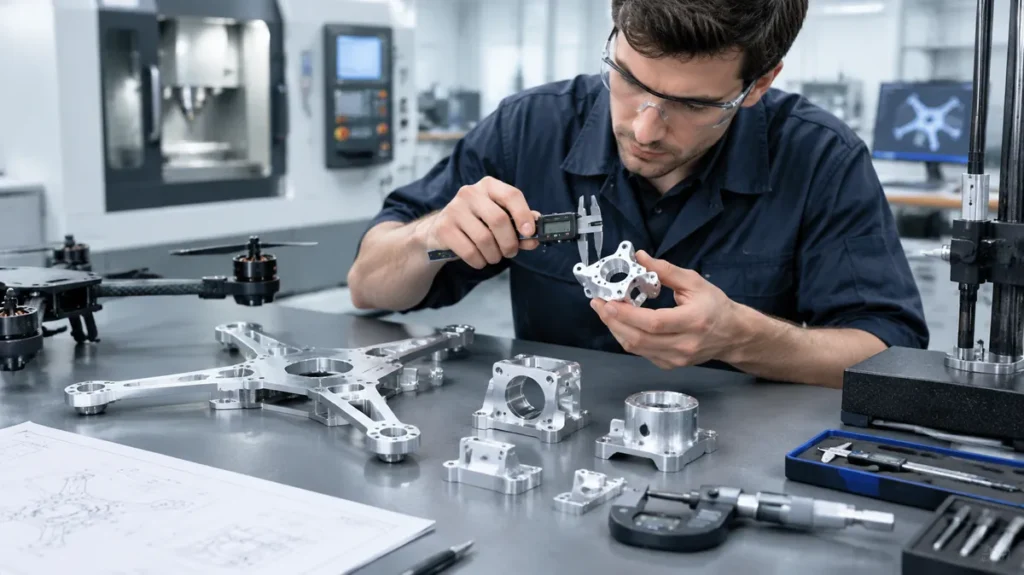
- Your CNC manufacturing partner directly impacts drone product quality and development timeline. Drone manufacturers should assess vendors by multi-axis capacity, material expertise, inspection workflows and engineering support.
- A qualified supplier must operate multi-axis equipment and hold hands-on experience producing aerospace-style precision components. They should support prototype validation, small batch runs and scaling to mass production.
- Formal quality documentation is essential for professional drone programs. Reliable suppliers supply full inspection reports and maintain consistent standards across every production batch.
- UAV product teams can partner with a professional custom CNC machining service to boost part reliability and mitigate manufacturing risks. A supplier with mature 5-axis capabilities can turn complex high-precision designs into repeatable finished parts.
Conclusion
- Today’s drones demand lightweight, strong components manufactured to exceptional accuracy standards. 5-axis CNC machining empowers drone OEMs to fabricate sophisticated mechanical parts with better performance and reliability.
- From aluminum frames and motor mounts to intricate gimbal assemblies, CNC machining delivers the precision required for demanding UAV applications. Selecting the right manufacturing partner enables engineering teams to refine designs, shorten development cycles and maintain consistent production quality.
FAQ About 5 Axis CNC Machining Drone Parts
- Why is 5-axis CNC machining suitable for drone components? 5-axis CNC machining excels at manufacturing complex geometries with high precision. It reduces repeated fixture setups and improves consistency for lightweight structural drone parts.
- What materials are commonly used for CNC machined drone parts? Typical materials are aluminum 6061, aluminum 7075, POM, PA66, PEEK and carbon fiber composites. Material selection depends on strength, weight limits, working environment and application requirements.
- Which drone parts can be manufactured using CNC machining? CNC machining produces drone frames, motor mounts, landing gear, gimbal hardware, camera brackets and other precision mechanical assemblies for UAV systems.
- How can engineers reduce CNC machining costs for drone parts? Engineers can cut manufacturing costs by applying DFM principles, selecting appropriate materials, removing unnecessary design complexity, and involving CNC suppliers in the early design phase.


