
China has become a major sourcing destination for custom CNC machined components, offering a broad supplier base for mechanical engineers, sourcing managers, and hardware startups in North America and Europe. From simple aluminum brackets to complex 5-axis components, Chinese CNC machining suppliers support prototyping, low-volume manufacturing, and larger production programs. However, factory capabilities, quality systems, engineering support, and production models vary significantly. This guide helps international buyers understand the supplier landscape, evaluate critical vendor qualifications, and reduce risks when sourcing precision CNC parts from China.
Editorial note: This is a practical sourcing framework for custom CNC procurement. There is no universal “best” factory, and vendor performance changes over time. All capability checks must be confirmed directly with suppliers before placing orders.
1. How We Evaluate CNC Machining Factories in China
A reliable supplier should demonstrate more than access to CNC machines. We consider the following factors when assessing potential manufacturing partners:
- Machining capability: 3-axis, 4-axis, 5-axis milling, CNC turning, Swiss machining, and mill-turn capability.
- Material experience: Aluminum, stainless steel, carbon steel, brass, copper, titanium, and engineering plastics.
- Quality management: ISO 9001 or relevant industry certifications, inspection equipment, traceability, and documented quality procedures.
- Engineering support: Drawing review, DFM feedback, tolerance evaluation, and process planning.
- Order flexibility: Ability to support prototypes, custom low-volume CNC machining, and repeat production.
- International sourcing experience: Export documentation, technical communication, packaging, and shipping arrangements.
A company offering many processes is not necessarily the best supplier for every project. Buyers should prioritize demonstrated experience with similar parts and manufacturing requirements.
2. Key Factors to Verify Before Working with Chinese CNC Suppliers
Before sending an RFQ, verify these five areas:
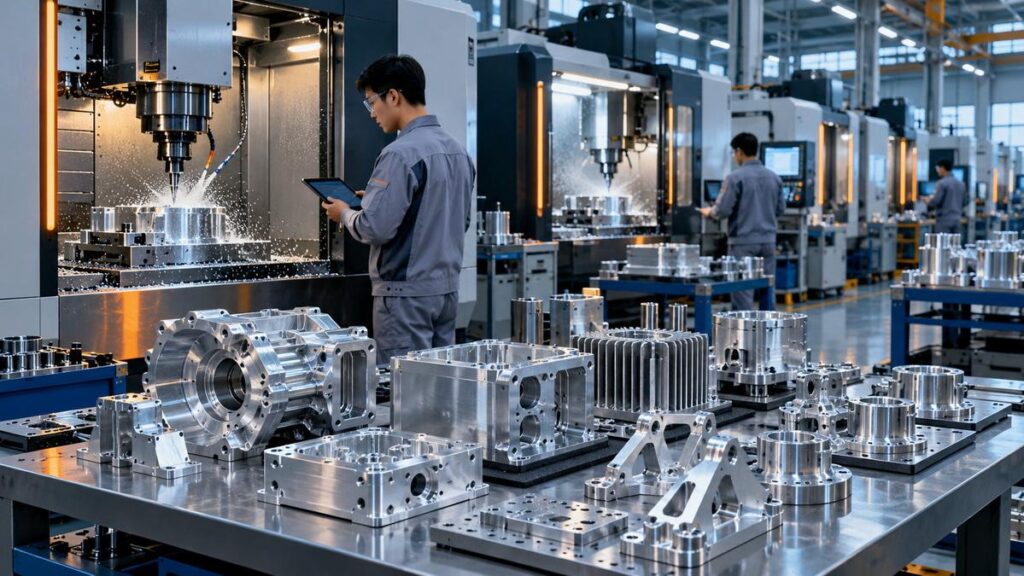
- Actual factory capability: Ask whether machining is performed in-house or outsourced. Request equipment lists and recent examples of comparable parts.
- Quality documentation: Confirm whether the supplier can provide material certificates, first article inspection reports, CMM measurements, and inspection records.
- Tolerance capability: Discuss critical dimensions individually. Do not assume that a general tolerance statement applies to every material, geometry, and production quantity.
- Surface finishing: Confirm whether anodizing, powder coating, passivation, polishing, plating, or other finishing processes are performed internally or through qualified partners.
- Commercial transparency: Compare tooling, setup, machining, finishing, inspection, packaging, shipping, and payment terms rather than evaluating unit price alone.
3. Common Types of CNC Machining Vendors in China
CNC service providers in China fall into several distinct categories, each suited for different project needs. Understanding these categories helps you narrow down your shortlist efficiently:
- Multi-axis precision specialists: Focused on 5-axis machining, Swiss turning and mill-turn work. They are the better fit for complex aerospace, medical, robotics and semiconductor parts with tight geometric tolerances. They usually stock high-performance alloys including titanium, 316L stainless steel and PEEK.
- General CNC job shops: Offer 3/4-axis milling and standard turning for aluminum, stainless steel and brass. Ideal for standard automation brackets, fixtures and mechanical components, with balanced cost and lead time.
- Rapid prototyping providers: Built for fast turnaround. They combine CNC machining with vacuum casting, 3D printing and rapid tooling, designed for product development teams iterating early-stage designs.
- Large-scale production manufacturers: Optimized for high-volume runs. They are less suitable for one-off prototypes and small batches, as setup costs and minimum order rules are common.
- Specialized finishing-focused vendors: Outsource machining work and mainly handle anodizing, powder coating, plating and polishing. Avoid them if you require full in-house process control from raw stock to final inspection.
Every category has its strengths and limitations. Your project’s geometry, material, tolerance, order size and certification requirements should decide which vendor type you select.
4. Tips for Sourcing from China CNC Shops
For US and European buyers, successful sourcing depends on controlling technical and commercial risks before production begins.
Prepare a Complete RFQ Package
Include:
- 2D engineering drawings with GD&T.
- 3D CAD files in STEP or IGES format.
- Material grade and temper.
- Surface finish and coating specifications.
- Required quantity and expected repeat orders.
- Critical dimensions and inspection requirements.
- Packaging and delivery destination.
A complete RFQ helps suppliers calculate machining time, material costs, tooling requirements, and inspection costs more accurately.
Request a First Article Inspection
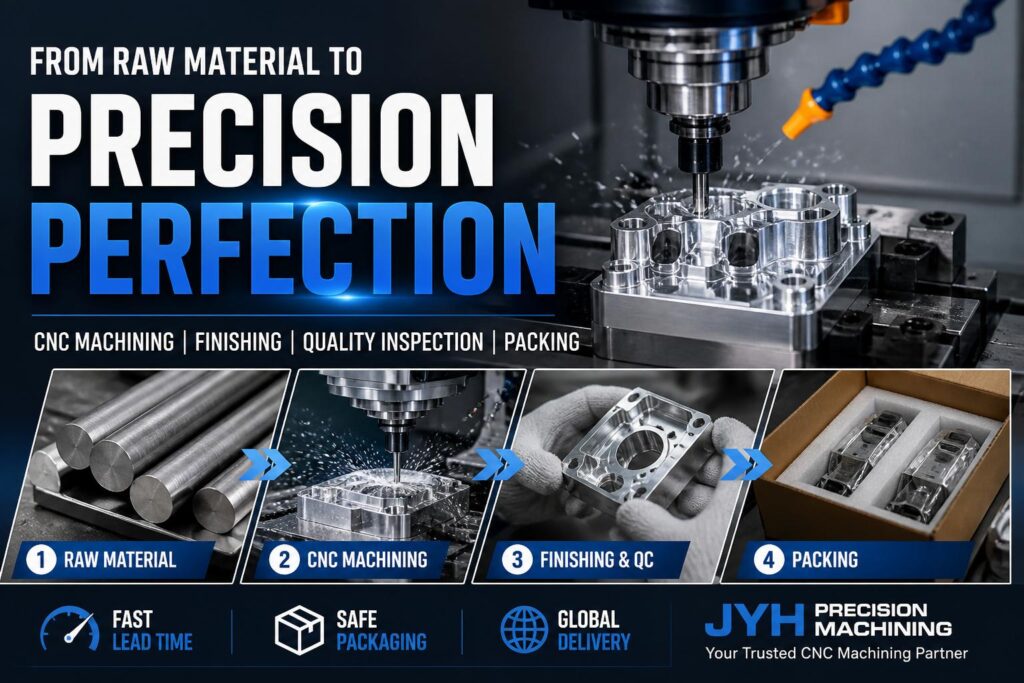
For precision parts, consider approving a first article before releasing the full batch. Request dimensional reports for critical features and material certificates where required.
Confirm In-House Manufacturing
Ask which operations are performed in the supplier’s own factory. This is particularly important for 5-axis machining, precision turning, anodizing, and other specialized processes.
Understand Lead Times
Prototype lead times depend on geometry, material availability, machining complexity, finishing, and inspection. Some suppliers advertise machining turnaround around five business days for standard projects, while more complex prototypes may require two to four weeks. International transportation and customs clearance should be added separately.
Consider Low-Volume Manufacturing
Hardware startups do not always need thousands of components. A number of Chinese factories accept one-piece prototypes or small production batches without a minimum order quantity.
However, low-volume CNC machining usually has a higher unit cost because programming, setup, and inspection expenses are distributed across fewer parts. A supplier that supports both prototype CNC machining and repeat production can simplify future sourcing.
5. FAQ
- What should I check before partnering with a Chinese CNC factory? Verify actual machining equipment, in-house production capability, material traceability, quality certifications, inspection equipment, tolerance experience, communication, and delivery terms. Request sample inspection reports and references for similar components before committing to a production order.
- Can Chinese CNC shops handle 5-axis and medical-grade parts? Yes. Some Chinese manufacturers offer simultaneous 5-axis machining and work with materials such as titanium, 316L stainless steel, and PEEK. However, machining a medical-grade material is not the same as manufacturing a compliant medical device. For regulated applications, verify ISO 13485 certification where relevant, material traceability, process validation, contamination controls, and applicable customer or regulatory requirements.
- What is the typical lead time for CNC prototypes from China? Simple CNC prototypes may be completed within approximately 5–10 business days after drawing approval and material confirmation. Complex 5-axis parts, special materials, or additional finishing can extend the schedule to two to four weeks or longer. Shipping time is additional.
- Do Chinese CNC machining suppliers accept small orders with no MOQ? Yes. Some suppliers accept single-piece prototypes and low-volume orders without a formal MOQ. However, setup and programming costs can make individual parts more expensive. Request quotations at several quantities to compare the economics of prototype and batch production.
6. Final Considerations
There is no single best CNC machining factory for every project. A supplier specializing in complex 5-axis parts may not be the most economical choice for simple aluminum brackets, while a rapid prototyping provider may not be ideal for long-term production requiring strict process control.
When evaluating Chinese CNC machining suppliers, prioritize engineering communication, manufacturing transparency, inspection capability, and repeatability rather than selecting solely on the lowest quotation. If you are sourcing precision prototype, drone, automation and medical CNC parts with no minimum order requirement, you can partner with experienced low-volume CNC manufacturers that focus on tight tolerance and DFM review for custom projects.


