
- CNC machining is a manufacturing process that uses computer-controlled machine tools to remove material from a solid workpiece and create precise, custom-designed parts. CNC stands for Computer Numerical Control. It enables manufacturers to produce complex geometries, consistent dimensions, and repeatable results directly from engineering drawings and 3D CAD models.
- CNC machining is widely used by mechanical engineers, OEMs, product developers, and procurement teams across industries including aerospace, medical devices, industrial automation, and unmanned aerial vehicles (UAVs). It excels for parts requiring tight tolerances, stable material properties, and precise fits.
- For companies developing new products or sourcing specialized components, CNC machining is an ideal solution for functional prototypes, engineering validation, and low-volume production.
How Does CNC Machining Work?
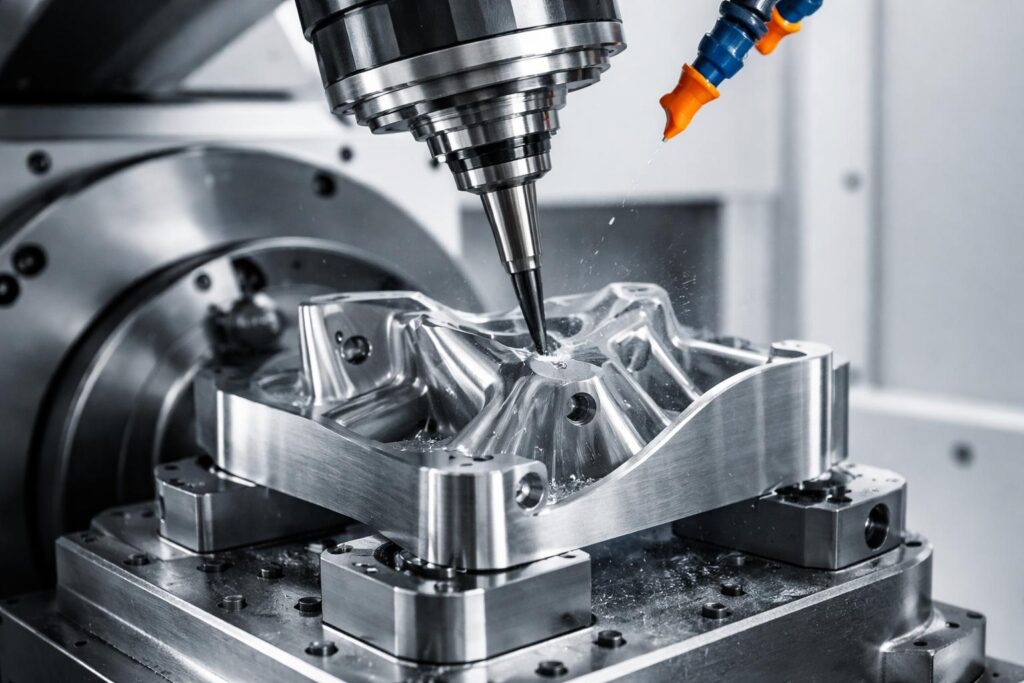
Understanding how CNC machining works starts with a digital design. Engineers create a 3D CAD model or technical drawing that defines the part’s geometry, dimensions, tolerances, and material requirements.
The typical CNC machining process follows five core steps:
- CAD design: Create a digital model with required dimensions and features.
- CAM programming: Convert the design into machine instructions via computer-aided manufacturing (CAM) software.
- Machine setup: Secure the workpiece, select cutting tools, and set coordinates and machining parameters.
- Material removal: The CNC machine follows programmed toolpaths to cut the workpiece into the target shape.
- Inspection and finishing: Verify critical dimensions, deburr parts, and apply required surface treatments.
CNC machines automatically control tool movement, spindle speed, feed rate and other parameters. This automation delivers consistent dimensional accuracy and reduces manual error.
Still, reliable results rely on fixture design, tool selection, material characteristics, machine capability and process planning. For high-demand components, a design-for-manufacturability (DFM) review catches problematic features, over-specified tolerances, and cost risks before production starts.
Common Types of CNC Machining
Different machining methods suit different part geometries. Choosing the right process improves accuracy, lead time and cost efficiency.
CNC milling uses rotating cutting tools to remove material from a stationary or repositioned workpiece. It works well for housings, brackets, plates, fixtures, pockets, slots and complex 3D surfaces.
CNC turning spins the workpiece against a fixed cutting tool. It is widely used for cylindrical components: shafts, bushings, pins, threaded parts and precision spacers.
The key difference between CNC milling and CNC turning is which element rotates during cutting. Milling fits prismatic parts and complex surfaces; turning is more cost-effective for rotationally symmetrical parts. Many custom components combine both operations.
5-axis CNC machining controls movement along three linear axes plus two rotational axes. Tools can reach multiple angles in fewer setups, supporting sophisticated geometries. It is preferred for aerospace parts, precision fixtures, impellers and components with angled compound surfaces.
The best process is determined by part geometry, tolerance requirements, material and production volume.
Popular Materials for CNC Machined Parts
Material selection impacts strength, weight, corrosion resistance, machinability and total cost. Common options:
- Aluminum alloys: Lightweight, corrosion-resistant and easy to machine. 6061 is standard for brackets, housings and prototypes; 7075 is chosen for higher strength needs.
- Stainless steel: Durable and corrosion-resistant. Grades 304 and 316 are common for industrial and medical components.
- Carbon & alloy steel: Used for parts needing high strength and wear resistance.
- Engineering plastics: POM, PEEK, nylon offer light weight, insulation and special chemical or thermal performance.
- Titanium: Outstanding strength-to-weight ratio and corrosion resistance for critical aerospace and medical parts.
Material selection should consider operating temperature, mechanical load, environment, compliance rules and dimensional stability.
Typical Applications: Medical, Aerospace, Automation, and UAV
CNC machining shines where accuracy and consistent performance are non-negotiable.
- Medical: Instrument components, equipment housings, custom fixtures. Material biocompatibility and regulatory requirements must be addressed.
- Aerospace: Machined brackets, structural fittings and interfaces to meet strict weight and tolerance specs.
- Industrial automation: Robot mounts, end-of-arm tooling, machine fixtures and alignment assemblies.
- UAV & drone: Motor mounts, sensor brackets, structural interfaces and lightweight housings for testing and integration.
Engineers in these fields usually require custom parts built to unique CAD files, rather than off-the-shelf standard parts.
CNC Machining for Prototypes and Low-Volume Runs
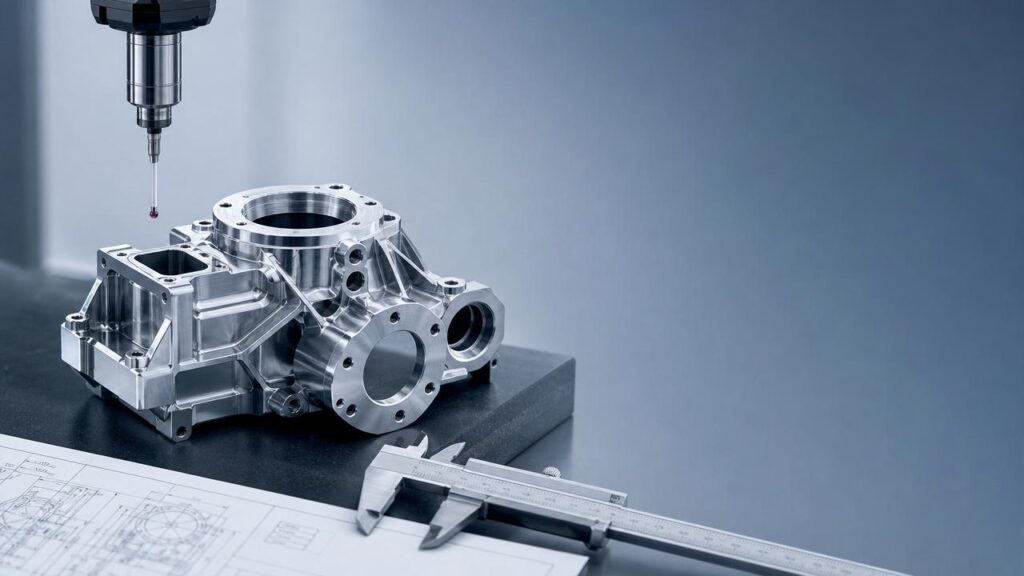
CNC machining stands out for custom prototypes and small batches, with no expensive dedicated mold tooling required.
Unlike molding or die casting, CNC parts are machined directly from CAD files. This makes it perfect for fit checks, functional testing, design iteration, pilot builds and replacement components.
For low-volume CNC projects, a supplier with strong engineering support adds huge value. A full DFM review flags thin walls, hard-to-reach features and unnecessarily tight tolerances upfront.
Procurement and engineering teams should evaluate these factors when sourcing:
- Tight tolerance capability, matched to geometry, material and inspection method
- Flexible prototype support for iterative design changes
- Small-batch order flexibility aligned with testing and launch schedules
- Formal dimensional inspection reports for quality traceability
- Wide material grades, surface finishes and secondary operation options
A skilled CNC machining partner balances technical requirements, manufacturability, lead time and cost — critical for OEM teams validating designs before scaling up.
Conclusion
CNC machining is a versatile subtractive manufacturing method for precision metal and engineering plastic parts. Powered by CAD design, programmed cutting and dimensional inspection, it delivers repeatable quality for complex geometries.
For engineers and OEM procurement teams, CNC milling, turning and 5-axis machining offer flexible solutions for custom components. When vetting suppliers, prioritize clear engineering communication, DFM feedback, strict tolerance control, prototype capacity and documented inspection.
For custom prototypes and low-volume production, the right CNC partner turns your CAD model into an inspection-ready functional part and reduces sourcing risk.
Frequently Asked Questions
- What is the difference between CNC machining and 3D printing? CNC machining removes material from a solid blank; 3D printing builds parts layer by layer. CNC is preferred for tight tolerances, superior surface finish and production-grade metal parts. 3D printing works better for intricate internal lattices and some early concept prototypes.
- Is CNC machining suitable for prototypes and small batches? Yes. CNC machining is ideal for functional prototypes, design validation, pilot runs and low-volume orders, because parts can be produced directly from CAD without custom molds. The final fit depends on geometry, material, tolerances and quantity.
- What information is needed to request a CNC machining quote? Share a 3D STEP or equivalent neutral CAD file, plus a 2D drawing marking critical dimensions and tolerances. Include material grade, surface finish, quantity, inspection requirements and target lead time. This helps your supplier complete a DFM check and send an accurate quotation.


