Meta Title: Die Casting Design Guidelines for Custom Metal Parts Meta Description: Learn die casting design rules, wall thickness, draft angle, radii and common defects for aluminum & zinc die cast components.
What Is Die Casting? Die casting is a high-volume metal manufacturing process that forces molten non-ferrous metal, most commonly aluminum, zinc and magnesium alloys, into precision-machined steel dies under high pressure. The molten material rapidly solidifies inside the die cavity to form near-net-shape parts. This process excels at mass production of complex geometries with repeatable dimensional consistency. It is widely contrasted with CNC machining, which is better suited for low-volume prototypes and tight custom tolerances.
Key Die Casting Design Parameters
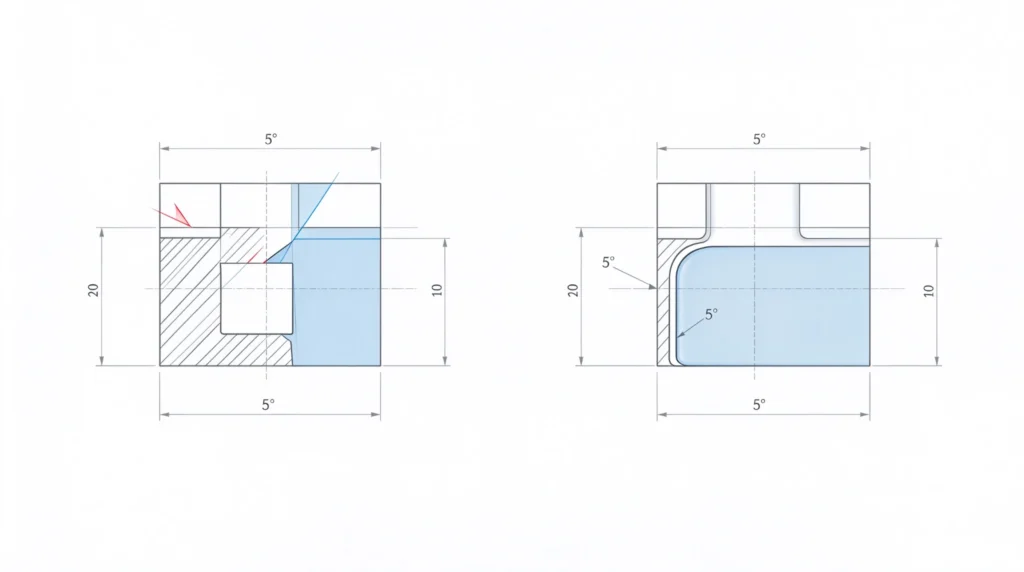
| Feature | Recommended Range | Note |
|---|---|---|
| Minimum wall thickness | 0.8 mm – 1.5 mm (Aluminum); 0.5 mm – 1.0 mm (Zinc) | Thinner walls risk cold shuts and incomplete fill; thicker walls increase shrinkage porosity |
| Draft angle | 1° – 3° per side for aluminum; 0.5° – 1.5° per side for zinc | Required for easy ejection from the die; textured surfaces need larger draft |
| Minimum fillet radius | 0.5 mm | Sharp internal corners create stress concentration and hot spots |
| Undercut | Avoid where possible | External undercuts require side actions and raise tooling cost |
| Small hole diameter | ≥ 1.5 mm | Smaller pins bend or break under high injection pressure |
Common Die Casting Defects & Design Fixes
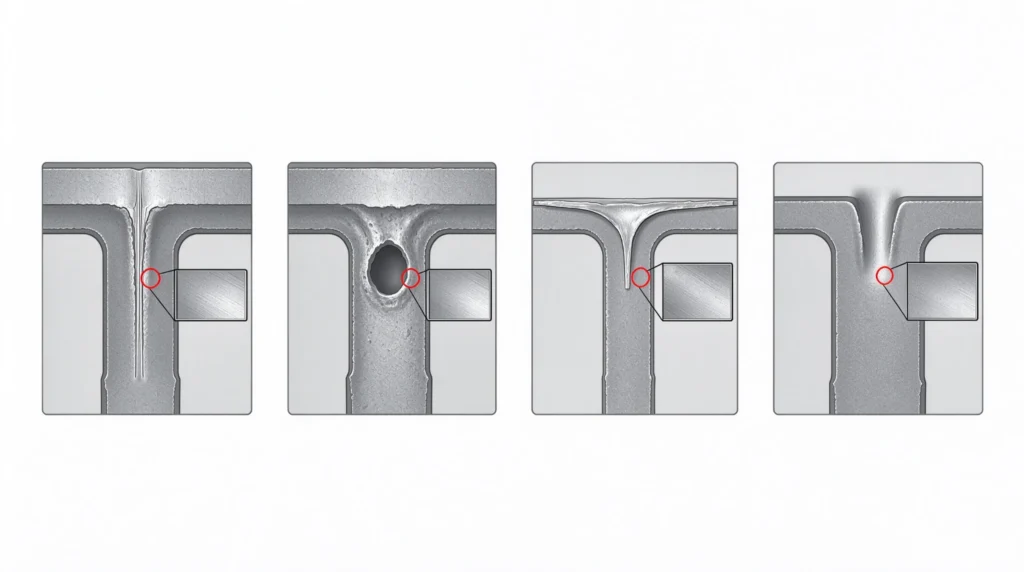
- Cold shut: Caused by converging metal flow fronts that fail to fuse fully. Fix: Adjust gate location, smooth flow paths, avoid overly thin isolated sections.
- Shrinkage porosity: Forms as molten metal cools and contracts. Fix: Add generous radii, avoid heavy thick sections adjacent to thin walls.
- Flash: Excess metal along parting lines. Fix: Keep parting lines simple, control wall thickness variation.
- Ejection marks: From ejector pins. Fix: Place pins on non-critical cosmetic surfaces, add sufficient draft.
Suitable Materials for Die Casting Aluminum alloys (A380, A413, A356) are the most popular. They balance light weight, strength, thermal conductivity and cost. Zinc alloys offer excellent fluidity for ultra-thin details and superior surface finish. Magnesium is selected for lightweight applications in automotive and aerospace.
Die Casting vs CNC Machining Die casting is economical for high order volumes, but the upfront steel die tooling cost is high. Design changes after tooling completion are expensive. CNC machining has no hard tooling cost, supports fast design iterations and tighter tolerances, but unit price rises sharply for large batch sizes. For prototype and low-volume custom metal components, CNC machining is often the preferred route.
Applications Die cast components are found in automotive housings, e-bike frames and brackets, consumer electronics enclosures, pump bodies, valve parts and household hardware.
FAQ Q: What is the biggest design mistake in die casting? A: Ignoring draft angles. Without proper draft, parts stick to the die and get damaged during ejection. Q: Can die casting hold tighter tolerances than CNC milling? A: No. Die casting tolerance is limited by die wear and thermal expansion. CNC machining can achieve far tighter precision for critical features. Q: Can I mix very thick and thin sections in one die cast part? A: It is not recommended. Uneven cooling creates porosity, warpage and internal stress.
If you need custom prototype and low-volume precision metal parts, our CNC machining service delivers accurate components for product validation.


