
Industrial automation equipment relies on mechanical components that deliver precise positioning, repeatable motion, and stable performance through long production cycles. Even minor dimensional deviations on robot brackets, linear motion supports or sensor housings can trigger misalignment, excessive vibration and costly unexpected downtime. For machine builders and system integrators, reliable CNC machined parts for industrial automation equipment are critical to guarantee assembly accuracy and long machine service life.
Custom CNC machining produces components tailored to unique load conditions, installation interfaces and motion specifications. From functional prototypes to serial production batches, this process delivers consistent dimensional accuracy required by modern automation systems.
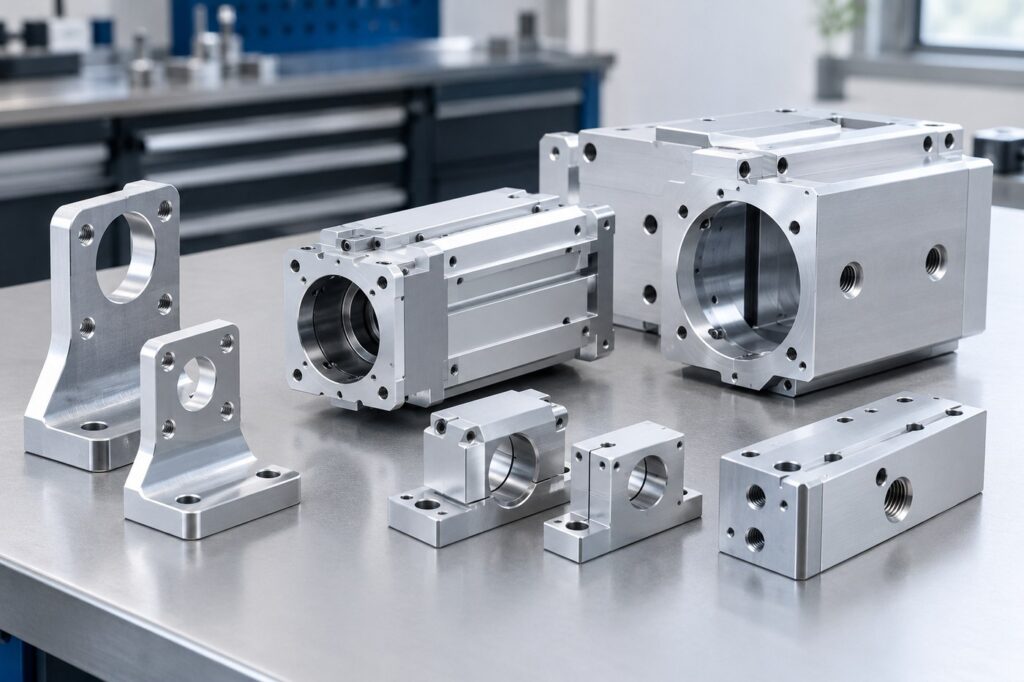
Why CNC Machining Is Ideal for Industrial Automation Components
Automation machinery integrates moving assemblies, precision sensors, pneumatic actuators and structural frames. Every part must fit mating assemblies perfectly while enduring repeated mechanical loads and continuous operating cycles.
CNC machining brings key advantages for automation hardware:
- Precise mounting & alignment: CNC milling and turning create controlled dimensions, flat reference surfaces and accurately positioned holes, keeping motors, bearings and guide rails perfectly aligned.
- Batch repeatability: Once machining programs and inspection workflows are finalized, critical features can be reproduced consistently across multiple production runs, ideal for equipment builders manufacturing identical automation stations.
- Design freedom: Custom automation CNC components can feature pockets, threaded holes, precision bores and complex mounting interfaces. Multi-axis machining cuts fixture setups for parts with features on multiple sides.
- Low tooling investment: Automation projects are rarely standardised. CNC machining supports custom dimensions and special interfaces without expensive dedicated molds.
For complex multi-face geometries, 5 axis CNC automation parts preserve positional accuracy across surfaces and reduce repeated re-clamping. The best machining method depends on part geometry, tolerance requirements and order volume.
Common CNC Machined Parts for Automation Equipment
CNC machined components are widely adopted in automated production lines, robotic workcells, inspection stations and material handling machinery.
Typical parts include:
- Robot mounting brackets & adapter plates: Connect robotic arms, end effectors and fixtures to machine frames
- Linear motion support blocks: Secure guide rails, bearings and sliding assemblies with precise mounting geometry
- Pneumatic & actuator housings: Fit cylinders, actuators and associated mechanical interfaces
- Sensor mounting components: Stabilize sensors for proximity detection, optical inspection and machine feedback
- End-of-arm tooling parts: Gripper fingers, locating pins, fixture plates and custom gripping interfaces
- Motor & gearbox mounting plates: Support drive units and maintain shaft/coupling alignment
- Precision shafts & spacers: Provide rotational support, controlled clearances and repeatable assembly positioning
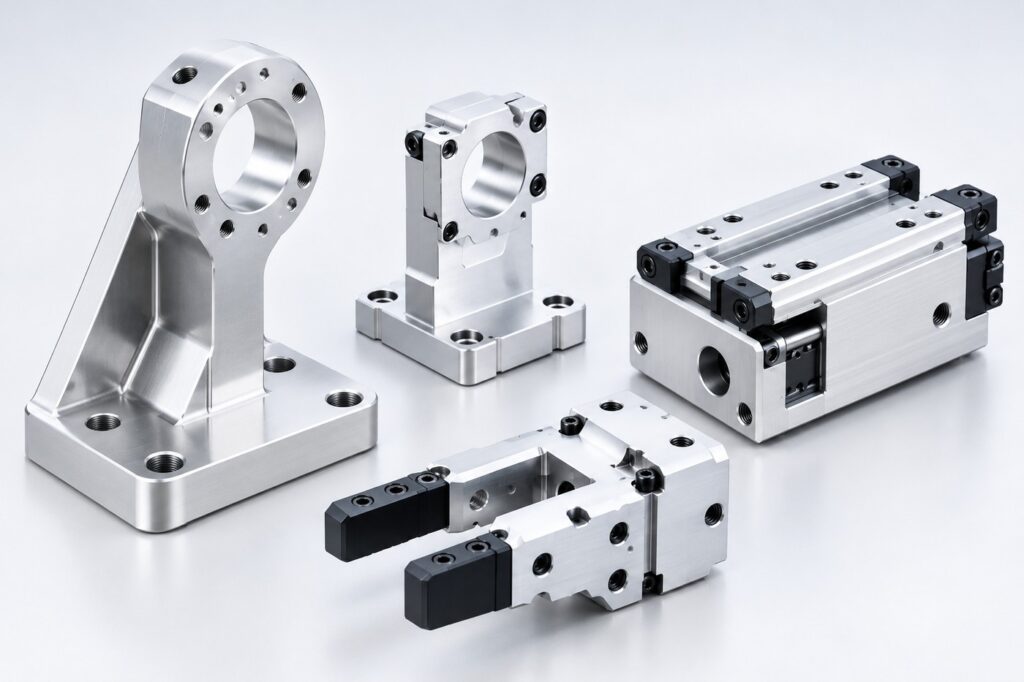
Part selection starts with machine function. Structural brackets prioritize stiffness and mounting precision, while gripper hardware requires light weight, wear resistance and tight contact geometry.
Material Selection for Industrial Automation CNC Partsa
- Material selection directly impacts part strength, weight, wear performance, machinability and total manufacturing cost. Engineers should evaluate materials based on real working environments instead of only unit price.
- Aluminum alloys are the top choice for lightweight brackets, sensor mounts, actuator housings and robot tooling. CNC machined aluminum automation parts balance strength and low weight, and anodizing surface treatment improves corrosion resistance and surface durability.
- Stainless steel fits components exposed to moisture, cleaning chemicals or harsh factory environments, where high strength and corrosion resistance are required. Note that stainless steel usually has longer machining cycle time and higher cost than aluminum.
- Carbon & alloy steel is used for shafts, locating pins and heavy load-bearing components needing superior strength and wear resistance. Heat treatment may be applied, with careful consideration for dimensional stability and post-processing.
- Engineering plastics such as acetal and nylon work well for guide blocks, spacers and low-friction contact parts. Material feasibility depends on operating temperature, chemical exposure, load rating and dimensional stability demands.
- Material specifications must define alloy grade, heat treatment and surface finish, to avoid material substitution that harms assembly fit or service lifespan.
CNC Machining for Automation Prototyping vs. Serial Production
During equipment R&D, prototypes validate mounting interfaces, motion clearance, cable routing and assembly interaction before mass build.
CNC machining is perfectly suited for prototyping: parts are manufactured directly from CAD files. Engineers can adjust bore sizes, bracket thickness or fixture interfaces without costly tool rework.
For serial production, the focus shifts to repeatability, predictable lead time and cost control. Manufacturers optimize toolpaths, standardize setups, combine machining operations and create inspection checklists for critical dimensions.
Decisions made in prototyping directly affect production cost. Overly tight tolerances, hard-to-reach features or deep narrow pockets increase machining time with no performance gain. A DFM (design for manufacturability) review catches these issues before production starts. For automation builders ordering small & medium batches, this step minimizes revisions and simplifies repeat orders.
Tolerance & Quality Requirements for Automation Machinery Parts
Not every feature on automation components needs ultra-high precision. Critical dimensions are defined based on their impact on alignment, movement, sealing and assembly.
For instance, bearing seats require strict dimensional control, while non-critical protective covers can use looser tolerances. Robot mounting surfaces demand controlled flatness and hole position accuracy.
When sourcing precision CNC machining for automation machinery, buyers should provide drawings clearly specifying:
- Dimensional tolerances for critical features
- Hole positions, thread specs and bore requirements
- Flatness, perpendicularity, concentricity for functional mating surfaces
- Surface finish requirements for sliding, locating or contact areas
- Material grades, heat treatment and surface finishing
- Inspection documentation and sampling requirements
Quality inspection uses calibrated measuring tools, CMM coordinate measuring machines, thread gauges and surface roughness testers, matching inspection methods to part accuracy requirements.
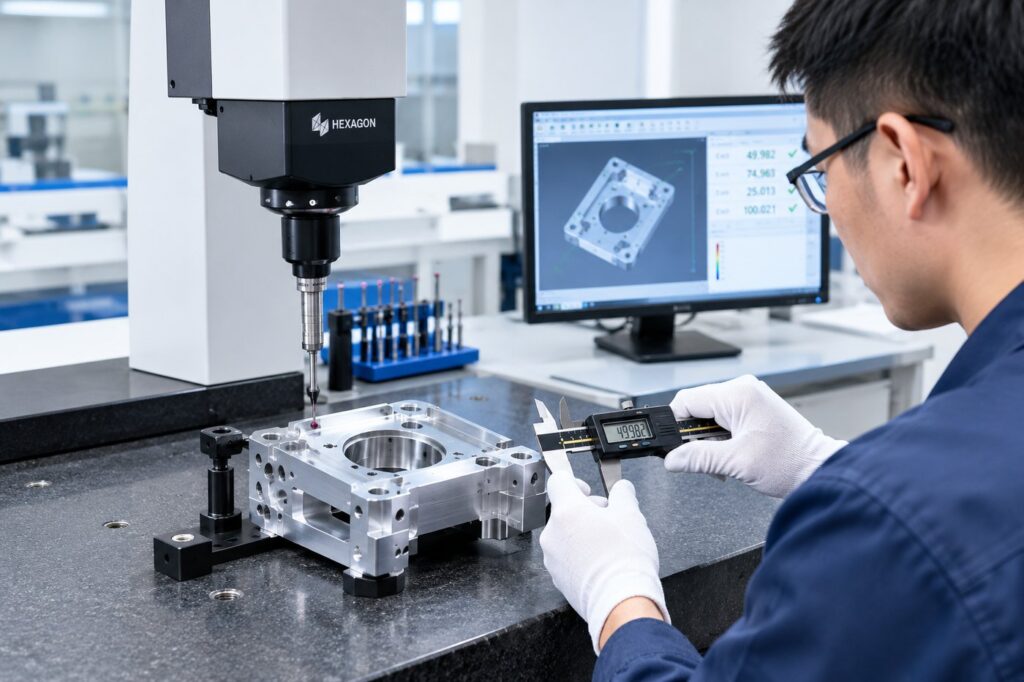
For repeat orders, standardized inspection procedures ensure consistent dimensional conformity across batches. Suppliers must clarify handling rules for non-conforming parts, drawing updates and material traceability.
Source Custom CNC Machined Parts for Industrial Automation
High-performance automation components start with clear definition of machine operating requirements, assembly interfaces and critical dimensions. Selecting proper materials, practical tolerances and production strategies balances mechanical performance and machining cost.
If you are developing new automation systems or sourcing replacement mechanical parts, submit your CAD files and 2D engineering drawings for an RFQ. Include material specs, order quantity, surface finish and critical tolerances. Our DFM review will highlight manufacturing considerations before production.
FAQ
- What CNC machined parts are widely used in industrial automation equipment? Robot mounting brackets, linear guide supports, actuator housings, sensor mounts, gripper fingers, motor mounting plates, precision shafts and custom fixture components. Design is determined by machine mechanical layout and operating conditions.
- What materials are recommended for CNC automation components? Aluminum for lightweight brackets and tooling; stainless steel for corrosion resistance; carbon/alloy steel for high-load wear parts; engineering plastics for low-friction guides. Material selection depends on load, environment, weight and tolerance requirements.
- Can CNC machining handle both automation prototypes and production batches? Yes. CNC supports one-off prototype validation and small-to-medium serial production. It allows flexible design revisions for R&D projects, and machining & inspection workflows can be optimized for larger repeat orders.


