
A well-prepared RFQ package is the foundation of accurate, comparable CNC machining quotations. When buyers omit key details, suppliers fill in gaps with their own assumptions, which leads to inconsistent pricing, delayed lead times, and parts that fail to match design expectations. This checklist guides engineers and sourcing teams to assemble all required information before sending out CNC machining RFQs.
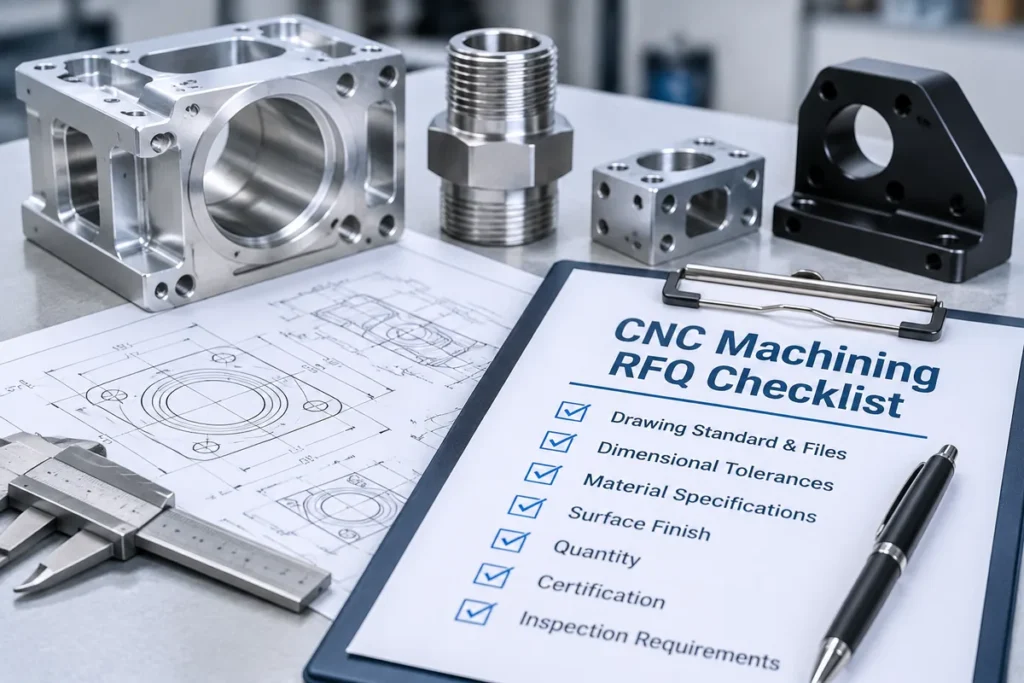
Definition
A CNC machining RFQ (Request for Quotation) is a complete set of technical documents that communicates your part requirements to a manufacturer. It covers geometry, tolerances, material, finishing, quantity, inspection, and delivery rules. Suppliers rely on these details to calculate machining time, raw material cost, secondary operations, quality work and lead time.
Why Use This RFQ Checklist
Without standardized RFQ information, two CNC shops can interpret the same part differently. One supplier may budget for masking and coating compensation, while another ignores tolerance risks and submits a lower but invalid quote. This checklist eliminates ambiguity, speeds up supplier response, and makes it easy to compare quotes fairly. Before submitting your RFQ, confirm you have covered: 2D drawings, 3D CAD files, material grade, tolerances, surface finish, quantity, surface treatment, inspection rules and delivery requirements.
Drawing & Technical Files
Engineering drawings are the core of any valid CNC quote. Inconsistent or outdated files are one of the most common causes of quotation errors. Buyer checklist:
- Provide 2D PDF engineering drawing + 3D STEP/STP CAD model
- State the drawing standard: ASME Y14.5 (GD&T) or ISO GPS
- Include units, projection type, revision number and drawing date
- Mark critical dimensions and functional features clearly
- Confirm the 2D drawing matches the 3D model North American projects commonly use ASME GD&T, while European buyers often follow ISO GPS. Never share multiple conflicting CAD revisions without flagging the latest approved version.
Dimensional Tolerances
Tolerance selection directly changes machining cost and inspection workload. Tight tolerances demand slower cuts, extra setup and CMM verification. Adding strict tolerances to non-critical features raises price with zero functional benefit. Buyer checklist:
- State general default tolerance for the part
- Highlight critical dimensions requiring tight tolerance
- Add GD&T controls for position, flatness, concentricity if needed
- Define thread specs and fit class
- Mark datum references, mating and assembly surfaces As an example: general features may use ±0.10 mm, while precision locating holes require ±0.02 mm. These are reference values only; achievable tolerances depend on material, geometry and process. Separating critical vs non-critical dimensions helps suppliers optimize cost.
Material Specifications
Stating only “aluminum” or “stainless steel” is not enough. Alloy grade, temper and material standard determine machinability, strength, corrosion resistance and price. Buyer checklist:
- Specify exact material grade and temper condition
- Reference applicable material standards
- List approved substitute materials if allowed
- Note whether material test certificates are mandatory
Common CNC machining grades:
- Aluminum 6061-T6: brackets, housings, general structural parts
- Aluminum 7075-T6: high-strength lightweight components
- 304 / 316 stainless steel: corrosion-resistant industrial parts
- 1045 carbon steel: structural mechanical parts
- Brass C360: fittings and threaded components
- POM, Nylon PA6: low-friction plastic parts
If substitutions are acceptable, write them clearly in the RFQ. Do not leave material choices open to the supplier.
Surface Finish & Secondary Operations
Finishing and post-processing add extra cost and can alter part dimensions, especially powder coating and anodizing on threaded holes, bores and sealing surfaces. Buyer checklist:
- Specify Ra surface roughness values
- Mark cosmetic vs functional surfaces
- List treatments: anodizing, powder coating, passivation, bead blasting, electropolishing
- Define coating color, target thickness and masking zones
- State deburring, edge break or polishing requirements
Common secondary finishes:
- As-machined: standard functional finish
- Bead blast: uniform matte surface
- Anodizing: wear and corrosion protection for aluminum
- Powder coating: durable colored exterior finish
- Passivation: improve corrosion resistance for stainless steel
Always remind suppliers to check if coating buildup will impact your tight tolerance features and threads. Masking or pre-coating dimensional compensation may be required.
Quantity & Production Requirements
Order quantity changes setup cost, unit price and production scheduling. A prototype run uses a completely different workflow from mass production. Buyer checklist:
- Separate prototype quantity and production batch quantity
- Share estimated annual volume and repeat order frequency if available
- Confirm partial shipment acceptance
- List target lead time and delivery date
- Define packaging and labeling requirements
Reference quantity tiers: 1–5 pcs: prototype validation 10–50 pcs: small batch 100–500 pcs: medium production 1000+ pcs: high-volume runs
Request pricing at multiple quantity breaks when you have a long-term project plan.
Inspection & Certification
Quality documentation is not automatically included in standard quotes. Requirements vary widely by industry. Buyer checklist:
- State if ISO 9001 compliance is required
- Request CoC, material certificates or FAI (First Article Inspection) as needed
- List critical dimensions that need formal inspection reports
- Specify CMM, roughness or hardness testing if mandatory
- Add industry-specific standards and traceability rules
For precision parts, clearly communicate which dimensions need inspection reports.
FAQ
- Can I send only a 3D STEP file for CNC quoting? A STEP file shows geometry, but it cannot fully communicate GD&T, tolerances, thread fits and surface specs. Always attach a 2D drawing for a reliable quote.
- What information gives me the most accurate CNC quote? Consistent 2D + 3D files, clearly marked critical tolerances, defined material grade, finishing requirements and confirmed quantity.
- Why do powder coating and anodizing matter for my tolerance? Both add surface layer thickness. Powder coating creates a much larger dimension shift, so threads, precision bores and mating surfaces usually need masking or pre-machining compensation.
We are a CNC machining factory based in China. We review complete RFQ packages quickly, check drawing feasibility, and provide transparent quotes for prototypes and small-batch precision parts.


