
Definition
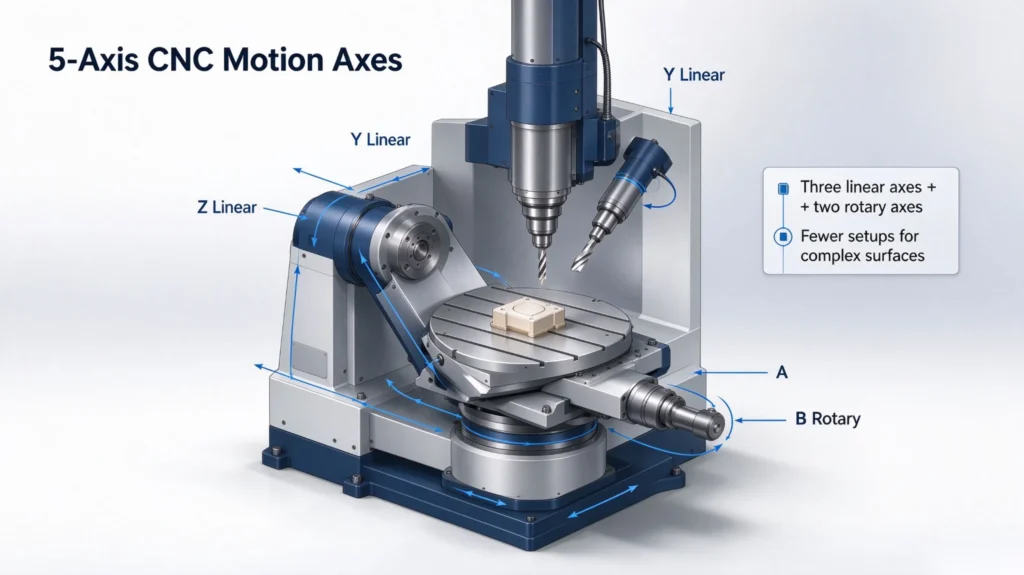
5-axis CNC machining is an advanced subtractive manufacturing process. The CNC system drives the cutting tool or workpiece to move along five axes in coordinated motion. Beyond the X, Y, Z linear axes, two rotary axes (A, B or C) let the cutter reach complex surfaces from nearly any angle.
Traditional 3-axis CNC only cuts from a fixed direction. 5-axis machining delivers intricate geometries with fewer setups, cutting repositioning errors and stabilizing dimensional consistency. It is the top pick for mechanical engineers, product designers and buyers working on parts with compound angles, deep cavities, curved contours and tightly aligned multi-side features.
How It Works
A 5-axis machine syncs linear and rotary motion to position the cutting tool. Two mainstream configurations are widely used: trunnion-style machines rotate and tilt the workpiece; swivel-head machines tilt the spindle instead. Selection depends on part size, access, rigidity and accuracy targets.
Standard workflow:
- CAD modeling: Create 3D files with geometry and critical feature specs
- CAM programming: Generate toolpaths, select cutting strategies and run collision simulation
- Workpiece setup: Secure raw material on fixtures and lock datum points
- Machining: Complete multiple faces in one clamping cycle
- Inspection: Validate dimensions, surface finish and GD&T tolerances
Key Parameters
Core factors to evaluate before machining: material (aluminum, stainless steel, titanium, PEEK and other engineering plastics), tolerance grade, Ra surface finish, tool clearance, workpiece envelope and production run size (one-off prototype or low-volume batches).
表格
| Comparison Factor | 3-Axis CNC Machining | 5-Axis CNC Machining |
|---|---|---|
| Movement | Three linear axes (X/Y/Z) | Three linear + two rotary axes |
| Suitable Geometry | Simple prismatic parts, straight features | Curved surfaces, angled holes, compound contours |
| Setups | Multiple re-clamping usually required | Minimal setups |
| Accuracy | Higher risk of alignment shift between operations | Less setup error, better positional consistency |
| Programming | Simple CAM programming | Advanced toolpath simulation required |
| Cost | Cost-effective for simple components | Higher programming & machine rate; saves cost on complex parts |
Pros & Cons
✅ Advantages
- Fewer fixture setups, less cumulative alignment error
- Improved tool access for angled features and hard-to-reach surfaces
- Optimized cutter angle delivers smoother surface finish and less tool deflection
- Supports consolidated part design, reducing assembly count
- Reliable repeatability for high-spec aerospace and medical components
❌ Limitations
- Higher hourly machine rate and CAM programming cost
- Mandatory collision simulation to prevent machine damage
- Thin-walled complex workpieces need custom fixturing to avoid deformation
- Not economical for simple flat parts; 3-axis machining is the better option
The right choice relies on part complexity, tolerance, order volume and total manufacturing cost — not just the number of axes.
Typical Applications
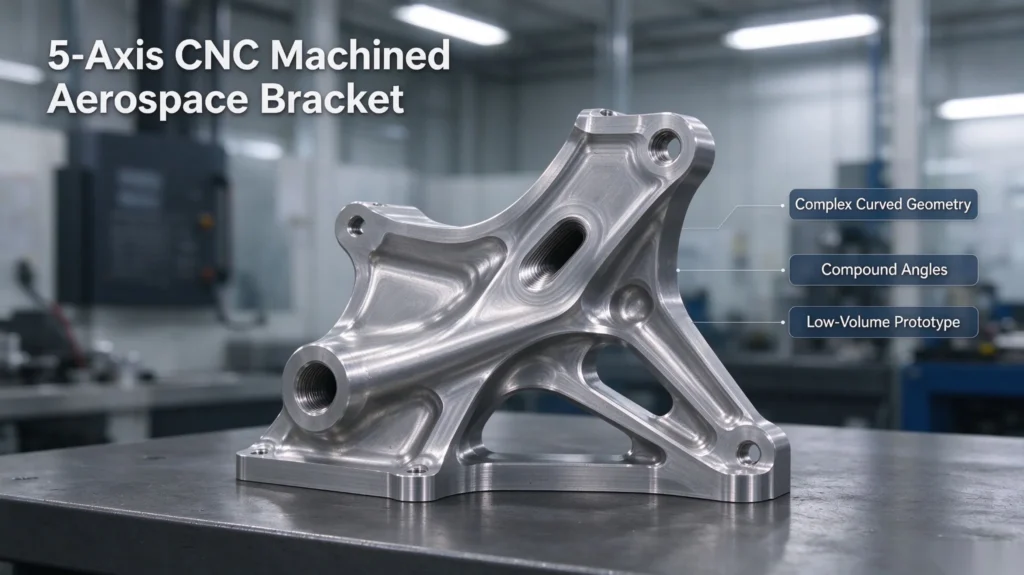
- Aerospace: Aluminum and titanium brackets, lightweight structural parts, complex housings and curved components
- Medical: Surgical instrument parts, orthopedic device hardware and precision enclosures
- Industrial automation: Robot end effectors, sensor mounts, custom fixtures and motion system components
- E-bike & mobility: Suspension brackets, motor housings and lightweight drivetrain parts
We provide 5-axis CNC prototypes and low-volume custom machined parts for these demanding industries.
Design & Machining Tips
- Reserve tight tolerances only for critical mating surfaces and bearing interfaces
- Use generous internal radii to match standard cutting tools
- Avoid ultra-thin walls prone to deflection under cutting force and heat
- Define stable datum surfaces and clamping positions early in design
- Submit STEP files + 2D drawings with GD&T notes for DFM review before quoting
- Lock material and finishing requirements upfront, as they directly impact machinability
FAQ
Q1: When should I pick 5-axis CNC machining over 3-axis? Choose 5-axis when your part has compound angles, continuous curved surfaces or features spread across non-parallel faces. Simple block-shaped parts are more cost-efficient with 3-axis machining.
Q2: What tolerances can 5-axis CNC machining hold? Achievable tolerance depends on material, part geometry, fixturing and thermal control. A 5-axis machine does not guarantee ultra-tight tolerance automatically. Mark all critical GD&T requirements clearly on your drawings.
Q3: What files do I need to prepare for a custom 5-axis machining quote? Send your 3D CAD model, 2D engineering drawing, material grade, surface finish specs, critical tolerances and order quantity. These details help us assess manufacturability, tooling, inspection workload, lead time and final cost.


