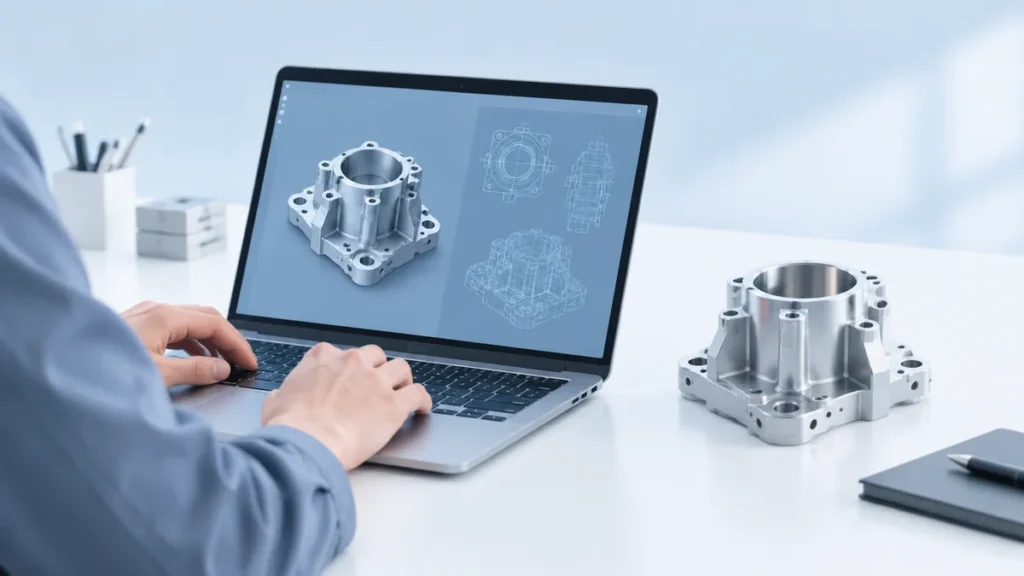
- CNC machining applications cover many industrial sectors.Industrial CNC machining produces high-precision mechanical components, functional prototypes and low-volume parts for modern manufacturing. Used widely across automation, industrial machinery, home appliances and consumer hardware, it delivers consistent dimensional accuracy and repeatable quality.
- Controlled by computer programs, CNC fabricates complex geometries with reliable surface quality. For mechanical engineers, product designers and purchasing managers, partnering with an experienced CNC manufacturer shortens development lead time and stabilizes component performance. In 2026, more businesses outsource CNC prototyping and small-batch runs to accelerate product launches and access cost-effective custom parts.
CNC Machining Application Scenarios
Industrial Machinery Components
- CNC manufactures custom brackets, shafts, housings, mounting plates, fixtures and assemblies for industrial equipment. Strict dimensional control is essential; minor machining errors can compromise equipment alignment and service life. Typical uses include machine structural frames, hydraulic and pneumatic components, precision bases, custom tooling and replacement spare parts. CNC milling and turning maintain consistent quality across batches for complex mechanical structures.
Automation & Robotics Parts
- Automation systems depend on precision CNC parts for stable motion. Common workpieces include robot end effectors, linear motion components, sensor brackets, motor mounts and positioning parts. Aluminum is widely preferred here for its lightweight structure, corrosion resistance and good machinability.
Home Appliance & Consumer Hardware
- Appliance manufacturers use CNC for both structural and cosmetic components: aluminum panels, decorative housings, heat sinks, support brackets and custom hardware. CNC achieves premium surface finishes without costly mold tooling for metal consumer parts.
Engineering Prototyping
- CNC prototypes are directly generated from CAD files. Compared with 3D printing, CNC prototypes use production-grade materials, offer higher mechanical strength, tighter dimensional accuracy and authentic surface finishes. Engineers validate assembly fit, function and manufacturability before mass production.
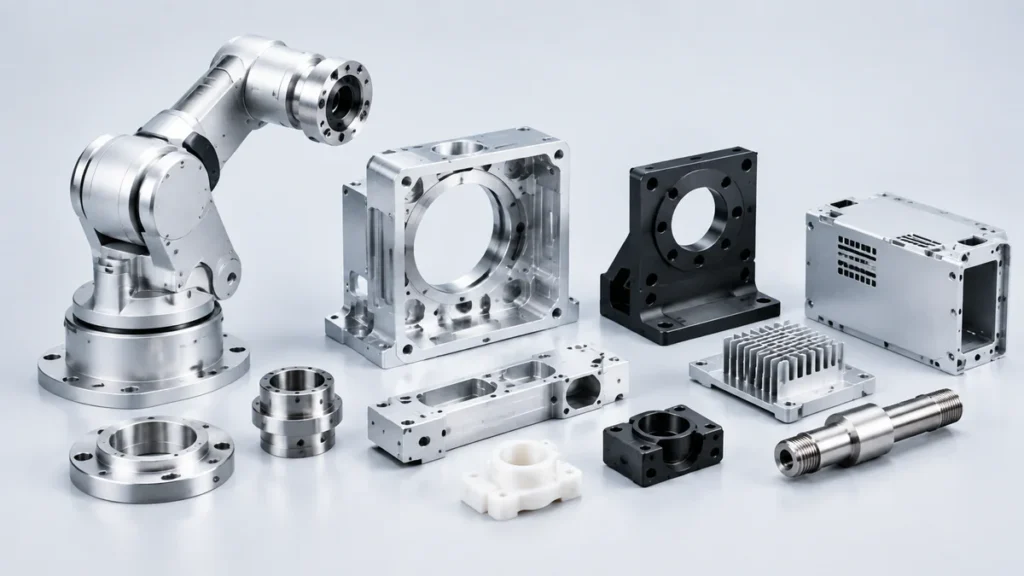
CNC machined parts for automation, industrial machinery and home appliance applicationsCNC Machining Materials
Material selection defines part performance, cost and service life.
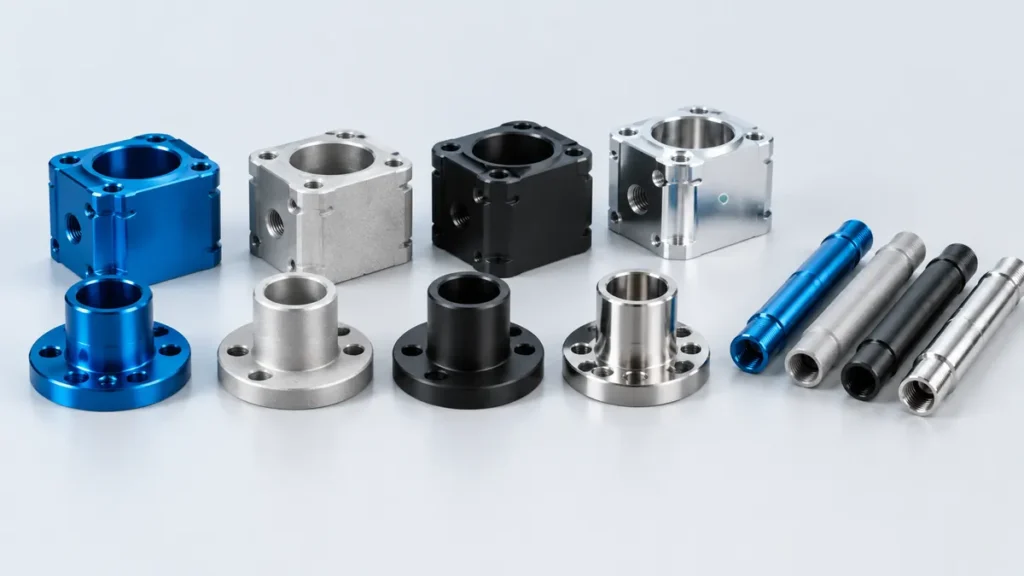
- Aluminum (6061,7075,6082): High strength-to-weight ratio, corrosion resistance, fast machining and suitable for anodizing. Ideal for automation, electronics housings and consumer hardware.
- Stainless Steel (304,316,17-4PH): Excellent strength and corrosion resistance for harsh environments. Used in food machinery, medical and outdoor industrial equipment.
- Engineering Plastics (POM, Nylon, PTFE, PC): Lightweight, electrically insulating and low-friction. Common for automation covers, test fixtures and electronic components.
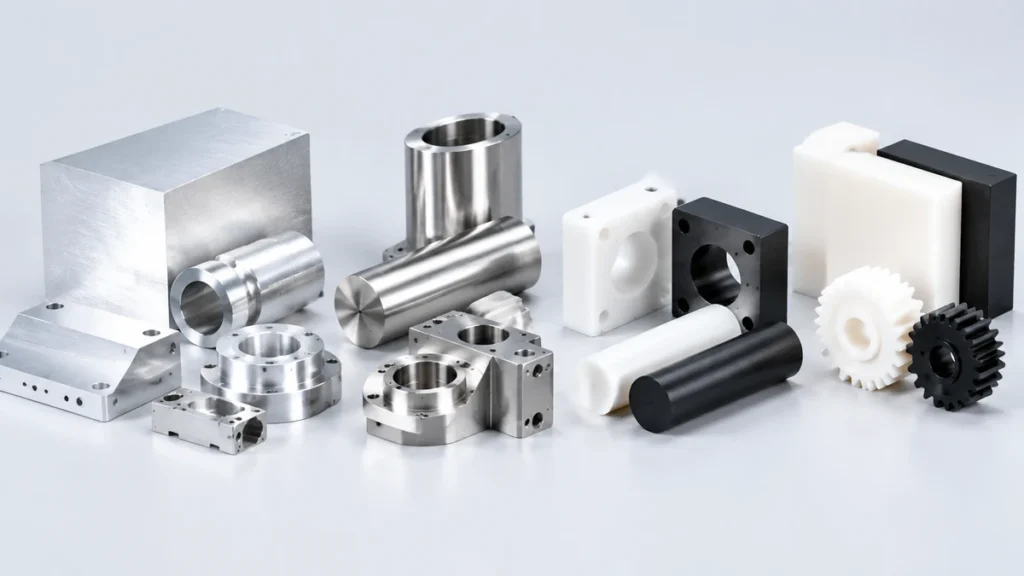
Common CNC machining materials aluminum, stainless steel and engineering plastic samplesTolerance Standards & GD&T
Tolerances determine assembly fit and functionality.
- General precision parts: ±0.05 mm
- High-precision parts: ±0.02 mm
- Ultra-precision specialized parts: ±0.01 mm
Achievable accuracy depends on material, geometry, machine precision, cutting tools and batch volume. Many buyers apply GD&T specifications such as flatness, parallelism, perpendicularity and concentricity. Clear tolerance requirements reduce rework and revision costs.
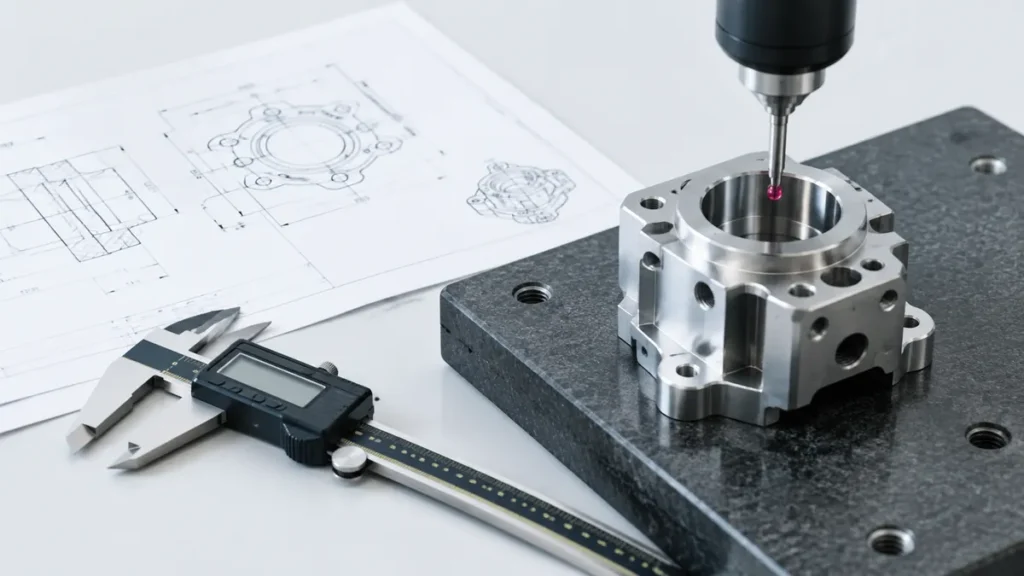
CNC part tolerance inspection and GD&T dimensioning for precision manufacturingDFM Guidelines for CNC Parts
Design for Manufacturing (DFM) cuts machining time and cost.
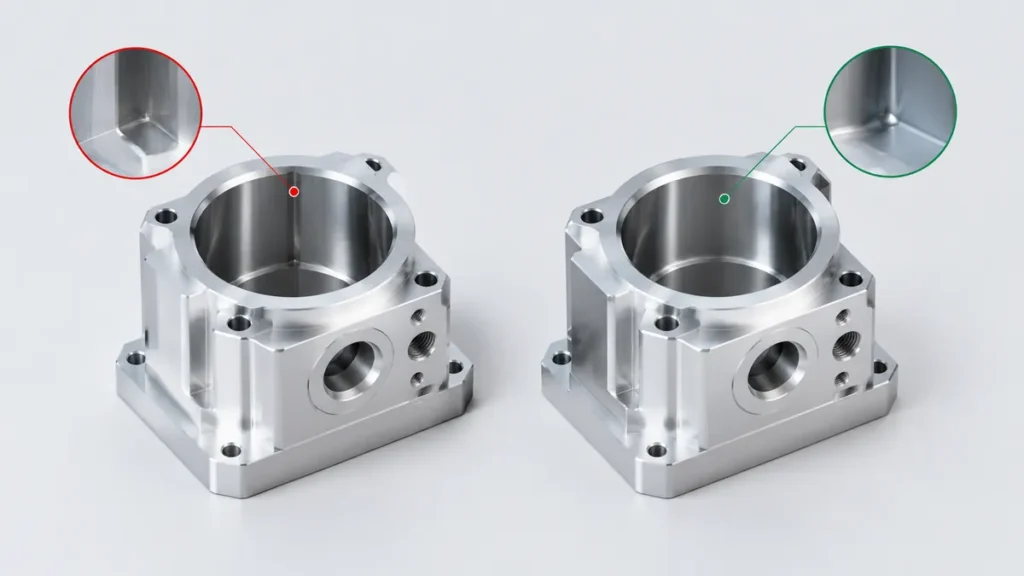
- Avoid overly deep cavities, which cause cutter vibration and accuracy loss. Reduce pocket depth and increase inner corner radii.
- Use larger internal corner radii. Milling cutters are round, so sharp inner corners cannot be directly machined.
- Maintain sufficient wall thickness; thin walls easily deform under cutting force. Add support ribs for fragile structures.
- Simplify complex geometry before production. Trusted CNC suppliers offer free DFM reviews.
Surface Finishing Options
inishes improve hardness, corrosion resistance and aesthetics:
- Anodizing (Type II / Hard Type III): For aluminum parts, adds hardness, corrosion protection and color choices.
- Bead blasting: Creates uniform matte surfaces to remove tool marks on housings and hardware.
- Powder coating: Wear-resistant colored protective coating for equipment frames and enclosures.
- Electropolishing & passivation: For stainless steel, enhances cleanliness and corrosion resistance for sanitary applications.
Why Outsource CNC Production in 2026
Outsourcing brings four key benefits:
- Faster product development: Quickly turn CAD models into physical prototypes to detect flaws early and speed up market release.
- Reduce capital spending: No need to invest in CNC machines, operators or in-house inspection equipment.
- Flexible low-volume manufacturing: Supports prototypes, pilot runs and custom small batches, perfect for automation OEMs and hardware startups.
- Access professional engineering support: Suppliers advise on material selection, DFM optimization, tolerance analysis and surface finish recommendations.
FAQ
Q: What industries use CNC machining most? A: Industrial machinery, automation, robotics, consumer hardware, electronics, medical, aerospace and automotive.
Q: What is standard CNC tolerance? A: Most industrial projects use ±0.05 mm. High-precision work can reach ±0.02 mm or tighter.
Q: How can I reduce CNC machining costs? A: Simplify part geometry, remove unnecessary tight tolerances, adopt standard cutters and follow DFM principles.
Q: Should I outsource or build an in-house CNC shop? A: Outsourcing grants instant access to equipment, skilled machinists and flexible capacity without large upfront investment.
Get a Custom CNC Machining Quote
Need CNC prototypes, precision components or low-volume production parts?
Send your STEP files, 2D drawings, material specs and tolerance requirements. Our team will review your design, provide DFM feedback and deliver competitive custom CNC machining quotes.